On 13 December 2024, Dr Marina Romanello waited in a Zoom studio with a slide deck that summarised the work of 122 researchers from more than 50 institutions.
She is the executive director of the Lancet Countdown, the research collaboration that publishes an annual academic assessment of how climate change harms human health.
Its 2024 report had come out a few weeks earlier, ahead of COP29, that year’s global climate conference.
The session was a special edition of Teach to Reach, the peer learning platform by and for people who work for health, hosted by The Geneva Learning Foundation (TGLF).
A week earlier, 24,610 health workers had registered for its eleventh edition.
Why health workers spoke first
The afternoon was one step in a sequence that began on 28 July 2023, when 4,700 health workers from 68 countries joined the first Teach to Reach event dedicated to climate change and health.
What they shared became On the frontline of climate change and health: a health worker eyewitness report, published at COP28 with testimony from more than 1,200 practitioners, almost three-quarters of them from the sub-national level.
Learn more: Climate and health: why we celebrate three years of local action today
When Charlotte Mbuh, TGLF’s director of programmes, carried that testimony to COP28, hostile accounts online asked since when health workers were authorities on climate:
“Unlike scientists or global agencies, we cannot be dismissed as experts from on-high. What we know, we know because we are here every day. We are part of the community.”
Through 2024, we tested that claim against the published literature.
Reading a scoping review of 511 papers on climate change, malaria, and neglected tropical diseases, Luchuo Bain, TGLF’s Fellow for Climate and Health, writing with Reda Sadki, found that only 34 considered mitigation and only 5 considered adaptation.
With so little published on adaptation, the experience of health workers who are already adapting fills a gap.
In November 2024, ahead of the dialogue, we examined the critical evidence gaps in the 2024 Countdown, a report that recognised health workers as “intimate witnesses” while its methodology privileged “internationally standardised data”.
In December, we put those questions to the Countdown’s executive director in person. The health workers spoke first.
Floods in the garden
Gifty Akosuwa Adzigbe, a public health nurse and disability health advocate from Ghana, answered from five years of watching.
In the dry, sunny season, she said, children and adults alike are coughing with upper respiratory infections.
The rains have changed too:
“We are now seeing floods, even in our small gardens.”
The vegetables are gone.
She then linked the lost gardens to antenatal care, where she and her colleagues teach pregnant women to eat from the four food groups.
“This pregnancy may not have vegetables to even feed on again when they come for antenatal care. The place has become so dry, nothing is there.”
The strain falls on health workers as well:
“We, the health workers, we are already to a psychological challenge because now we are confused.”
Other health workers helped her.
Through Teach to Reach, she said, “I realized that I had a stronger team.”
With that team, she reached people living with disabilities in her community and explained masks, handwashing, and other basic protections.
Her question for the scientist was: “What can we do, especially for people with disability when it comes to climate change and health?”
The calculus of climate and health: numbers are people too
After introducing herself, Romanello said: “It’s just so moving to hear the actual human stories behind much of what our numbers are showing us.”
Of about 15 indicators tracking the health threats of climate change, 10 had reached record highs in the most recent year of data.
- Heat-related deaths among people over 65 had risen by 167% since the 1990s, against the 65% increase that population ageing alone would have produced.
- Over the last decade, more than 60% of the world’s land area had seen more days of extreme rainfall.
- Heatwaves and drought were associated with 151 million more people facing moderate or severe food insecurity across 124 countries.
- Climate suitability for dengue transmission by one of its mosquito vectors had risen by 46.3% since the 1950s.
Several of these figures had already been described, before the slides, by people on the call.
Lynn Imanari, a researcher in child care and human development in the Philippines, said of the rains in November and December:
“We usually have rains, but not this heavy, not this intense.”
Taphurother Mutange, a Teach to Reach leader introduced as the person who had answered more Teach to Reach questions than anyone, described families displaced by floods into open places with no rooms, falling sick again and again: “And there were no medicine in the facility.”
She took the worst affected to the facility for first aid.
Gifty had described the food insecurity figure as an empty plate in an antenatal clinic.
Where the numbers stopped
Some questions went beyond what the Countdown measures.
Dr Amrita Mishra, who works in public health with women’s groups in several states of India, asked for models that women and communities could use to run their own early warning before heat waves, and for a place to find what other countries had tried.
Romanello said she was not aware of such tools in a form that health workers could use, and promised to come back to her.
Earlier in the session, Romanello had explained part of the problem.
“There’s very, very good predictive systems,” she said, but meteorological services are rarely linked to health systems, and “the information is not generally readily available to the communities, to frontline workers, to know how to respond.”
The forecasts exist, but they do not reach the health workers who would act on them.
Dr Raymond, who directs a climate and health alliance of practitioners in more than 30 African countries from Uganda, raised mental health: “an area that is being neglected is mental health.”
Romanello agreed and explained why the Countdown struggles to measure it.
Stigma hides cases, definitions are not standardised, and the data do not exist.
In the comments, Olajumoke Olufilipe wrote:
“People that are displaced by floods will have depression.”
Romanello drew the conclusion herself.
“We cannot quantify much of what you [are] experiencing on the ground,” she said, including mental health and cascading impacts, “because global data sources are not available.”
Yet “we have enough evidence to know that mental health is at the front line of climate change.”
She described what Teach to Reach had been collecting as “a robust source of knowledge, which it actually is.”
What the scientist concluded
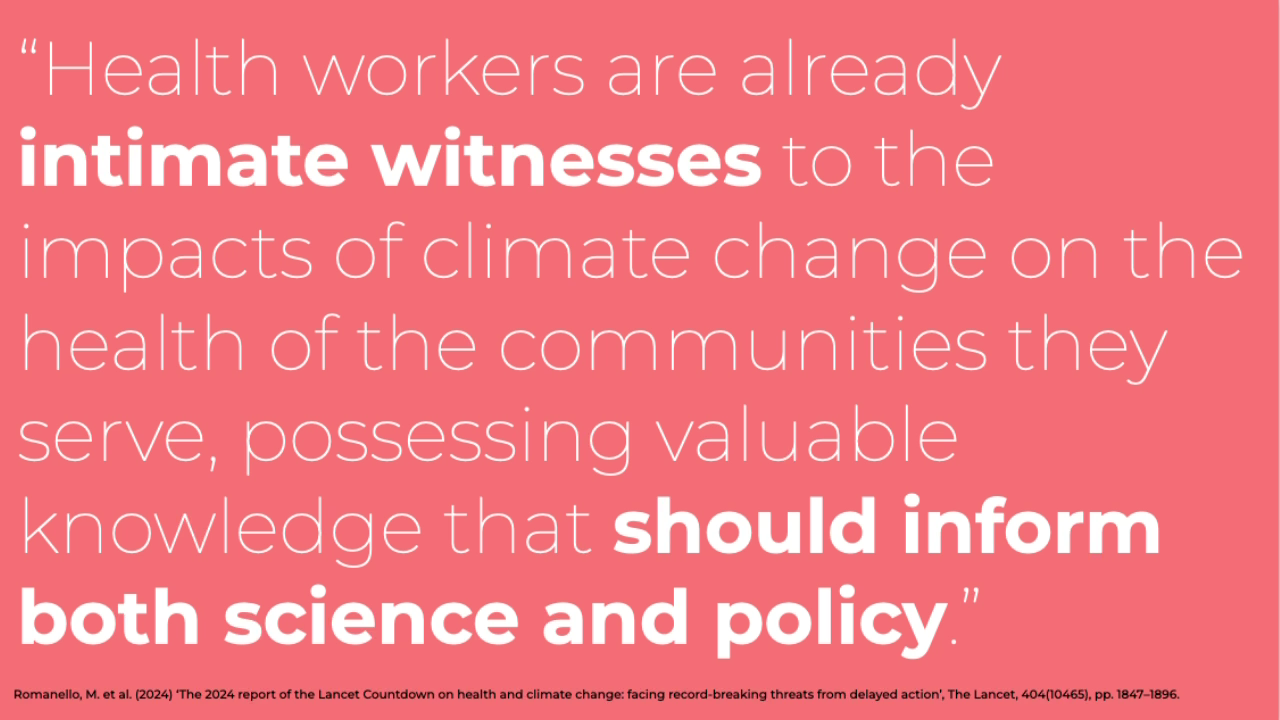
Near the end, we read her the sentence from her own report: “Health workers are already intimate witnesses to the impacts of climate change on the health of the communities they serve, possessing valuable knowledge that should inform both science and policy.”
We asked whether what she had heard confirmed it.
“Much of what we do is produce numbers that we validate through analytical methods but the biggest validation of the numbers that we show has to do with the experiences on the ground.”
She added:
“The stories behind those numbers can be the biggest driving force for action when you humanize the numbers.”
Our last question drew on Charlotte Mbuh, who began her career as a sub-national health worker in Cameroon.
At the COP28 Health Pavilion a year earlier, she had said:
“What we know, we know because we are here every day,” and “We are doing the best that we can, but we need your support.”
We asked Romanello what she would say to the health workers who echo that.
“I [do not] think we have done justice to the enormous amount of work that is going through frontline health workers. I [do not] think the international community has done justice to it.”
Then:
“There’s many of us that are your allies.”
Near the end of the session, Fatima Abubaker wrote in the comments:
“Thank you for listening to us and lending a hand.”
Her gratitude reflects how unusual this kind of dialogue remains. Health workers are rarely asked what they know before the global evidence is presented to them, and the scientists who produce that evidence are rarely in the room to hear the answer.
The day when The Lancet Countdown crossed over with Teach to Reach was very powerful: health workers speak first, the scientists present, and then both discuss what to do.
How can the Lancet count the value and significance of local knowledge?
The December dialogue was followed by two developments in 2025.
Following Teach to Reach 11, the Global Climate Change and Health Survey, developed by TGLF with support from Grand Challenges Canada, would gather more than 6,400 responses, around 61% of them through the Teach to Reach network, as described in our review of three years of this work.
The same year, the 2025 Lancet Countdown included frontline health worker testimonials in its country profiles for the first time, describing their “lived experiences as valuable evidence”, as we noted in the article exploring how the Countdown illuminates a new path to climate-resilient health systems.
It also stated that community-led actions are “more likely than top-down interventions to maximise health benefits”, which we documented in what the Lancet Countdown says about local knowledge and action.
What the health workers were already doing
In May 2026, the experiences shared before, during, and after Teach to Reach 11 became a listening and learning report.
Health workers were asked four plain questions.
- What exactly happened?
- What did you do?
- How did you know it worked?
- Did the community help, or make things harder?
100 “local solutions” from at least 19 countries were published in full, sorted into two families of action, emergency response and building resilience, with 17 distinct kinds of action across them.
Many accounts describe changes to practice.
- In Niger, Sidikou Issaka Maiga of the national malaria control programme kept a seasonal chemoprevention campaign running after floods cut off villages: “We recruited local distributors and brought them in by pirogue.”
- In Côte d’Ivoire, Konan Kouamé Georges, a public health doctor in Yopougon, responded to a dengue epidemic in an unusual rainy season by moving surveillance data “on a daily basis instead of on a weekly basis.”
- In the Democratic Republic of the Congo, Victoire Odia, a nurse in Ngandajika, described women who organised so that pregnant women from 32 weeks could reach the maternity ward around the floods: “Their stays were paid for by the women’s group solidarity fund.”
These and other accounts are gathered in 20 local solutions shared by health professionals.
One of the report’s eight findings is that health workers and their communities are already paying the cost of adaptation.
A midwife in Tarime, Tanzania, wrote:
“I have to hire a motorbike and sometimes the road is so slippery and you fall down in the mud, and the next day you even get sick.”
None of the accounts describes a reimbursement structure.
When these solutions were read back to health workers at Teach to Reach in July 2026, Tina Iroghama Agbonyinma said they did not surprise her.
“Local solutions are the first step that every health worker provides to secure the health of the community, before the state and national teams come in,” she said, as recorded in “I always face a flood”.
Betty Koech, a researcher at the Kenya Medical Research Institute, was surprised by “the level of flexibility that exists within the structures, the ability to change very fast and adapt.”
The anecdote objection
The usual objection to this evidence is that it is anecdote.
The reports print their limitations.
The contributions are self-reported and not independently verified.
The contributors select themselves, and they must be online, literate in English or French, and willing to write.
As Reda Sadki told colleagues at the Centre for Planetary Health at the London School of Hygiene and Tropical Medicine in December 2025:
“A nurse in Bangladesh noticing ‘more heatstroke’ is a signal, not a prevalence study. We are not claiming it is.”
TGLF’s claim is narrower.
When thousands of such signals are collected with structure and read together, they form patterns that small samples cannot show, faster than longitudinal studies can.
The choice is between acting on imperfect signals and waiting years for studies.
As we asked in Anecdote or lived experience: “Is the risk of error greater than the risk of inaction?”
The philosopher Donald Schön distinguished the “high, hard ground” of research-based theory from the “swampy lowlands” where the problems of greatest human concern lie, and where practitioners rely on what he called knowing-in-action.
- A health worker who moves surveillance from weekly to daily because the rains have changed is revising a protocol years before a guideline would recommend it.
- A women’s solidarity fund that pays for maternity stays is health financing that health systems frequently do not see.
The Countdown’s numbers cannot say which building becomes the clinic when the road floods.
There is a precedent for knowledge of this kind gaining recognition. Indigenous knowledge has begun to enter the scholarly record.
At Brazil’s first national seminar on Indigenous health and climate change, Putira Sacuena described a small frog in the Xingu whose silence had preceded outbreaks of respiratory illness and diarrhoea.
“This is ancestral science,” she said, as Reda Sadki recounted in Colonization, climate change, and indigenous health from Algiers to Acre.
Health worker observations could follow the same route, with structured collection, analysis, and publication.
What health workers asked for
If the evidence is accepted, the question becomes what kind of support follows from it.
The 2025 Countdown, for all its progress, still recommends that health systems “educate and train” a workforce it describes as “unprepared”.
A 2024 Lancet article on primary health care had made a similar case, which we examined in Strengthening primary health care in a changing climate.
Most of the questions health workers put to Romanello in December were about what to do: how to prepare before typhoons, how to protect people with disabilities, how to work together so that displaced families stop falling sick, and where to find early warning tools.
In August 2026, TGLF turned the accounts of health workers into an answer to that question: the 7-30 Climate-Health Emergency Framework, which “gives a shape to what you already do, so you can ask for support with evidence behind you.”
Within 7 days of a warning or seasonal sign, a local area is confirmed prepared, and within 30 days of an event starting, essential services are stable again, costs are recorded, and one action that makes next time easier is under way.
A free certification course helps health workers learn to use it in the communities they serve.
Learn more: Get the 7-30 Climate-Health Emergency Framework
Some gaps sit elsewhere.
On early warning for women’s groups, the gap in knowledge was at the global level.
In our experience across programmes, information pushed down a hierarchy degrades at each step, and the level of factual knowledge is rarely the binding constraint.
Health workers are held back by isolation from peers facing the same problem, no time to reflect on practice, no support during implementation, and no recognition of what they already do.
Gifty described the same thing when she said Teach to Reach gave her a stronger team.
In TGLF’s Impact Accelerator, measured against conventional technical assistance and cascade training in a 2019 immunization cohort, implementation was about seven times faster at about 90% lower cost.
In a Ministry of Health initiative in Côte d’Ivoire, 82% of participants continued using the method without further support, and 78% said they needed no further external assistance.
The contrast is with where most climate and health effort is directed.
The “ATACH”, or Alliance for Transformative Action on Climate and Health, hosted by WHO, works where commitments are made, with ministers and negotiators.
Its own evaluation found that, after roughly seven million dollars and three and a half years, 2 of 14 country members interviewed in depth could attribute a national policy change to it, and no health outcome data could be discerned.
As we set out in The road to transformative action on climate and health, nothing yet connects that work with what happens in a district health centre during a flood.
That is what made the December dialogue with Marina Romanello so important. It connected the science that informs global commitments with the communities where those commitments succeed or fail, and building such connections between science and community is vital to the future of climate and health action.
What it would take, and why the risk of backlash is growing
Funding has to reach community-led action within weeks, the timeline on which floods run.
The report’s 14 recommendations ask partners to reimburse climate-related transport and injuries, to recognise community financing as health system infrastructure, and to fund the documentation that turns tested practice into evidence.
In June 2026, at the launch of a new funding call in London, Reda Sadki warned that without commensurate investment in local action, “we will end up with better policy and better science. And, 5, 10, or 15 years down the line, communities will reject both,” as recorded in his remarks at the Nexa announcement.
During that December 2024 event, health workers described taking flood victims to first aid and teaching pregnant women what to eat when the gardens are gone.
Their colleagues in the 2026 report were hiring pirogues and moving surveillance to daily reporting.
The scientist who listened to them called their experience the biggest validation of her numbers, and said the world had not done it justice.