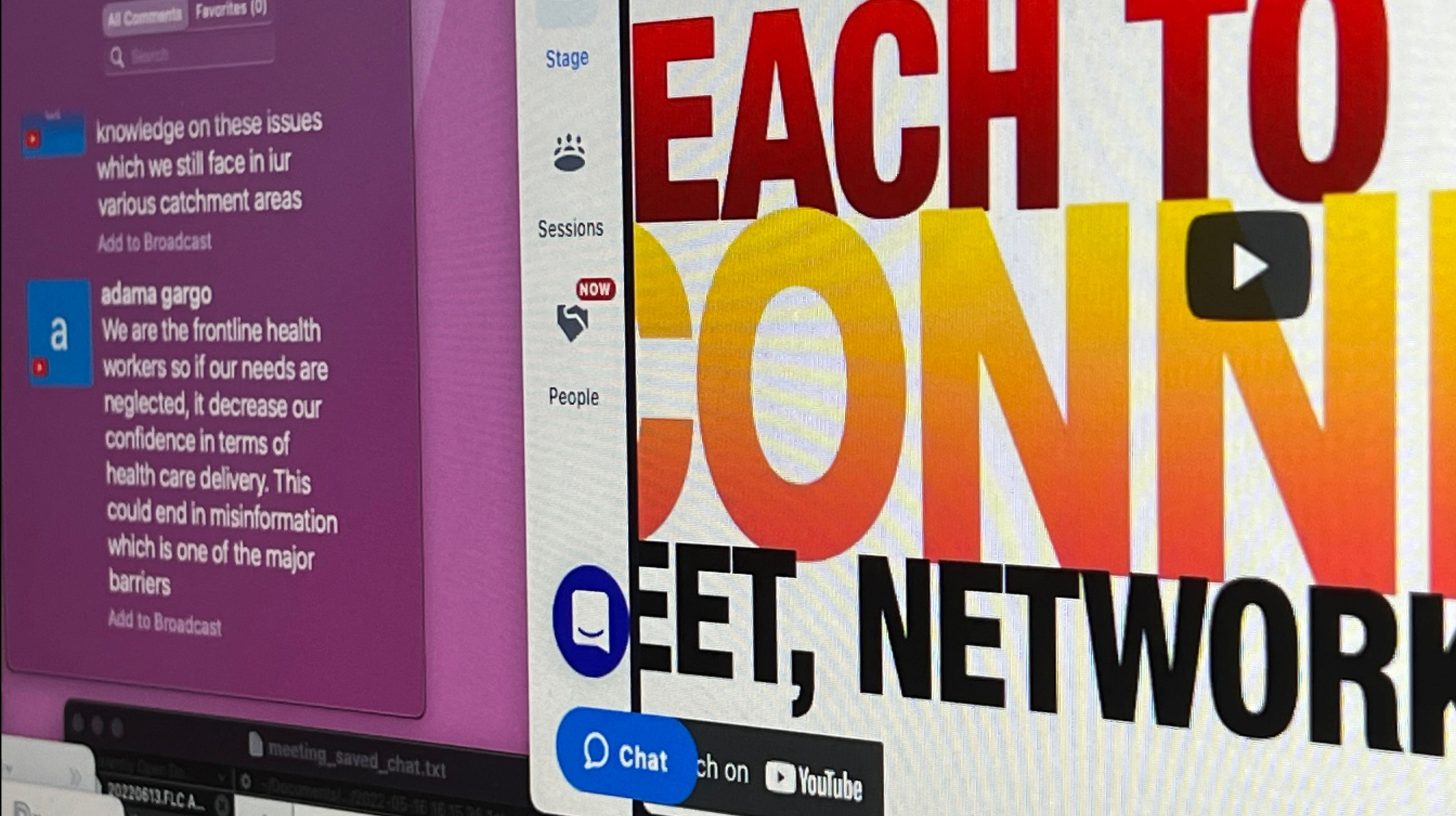
Three years ago today, on 28 July 2023, 4,700 health workers logged on from 68 countries to answer one question about climate change and health. This article revisits the event and explores how it sparked a nascent global movement led by people who work for health in local communities of Africa, Asia, and Latin America.
Where the companion pieces read the full three-year body of work, together with the eight take-aways, and fourteen recommendations drawn from Certificate peer learning programme for leadership in climate change and health, this article returns to the beginning. It asks why a single online event, built by a network created for vaccines, turned out to be a historical milestone and a powerful harbinger of things to come. And the retelling is by health workers who were in the room that day, in their own words.
On 28 July 2023, a community pharmacist in Aja, Nigeria, sat alone in front of a screen.
So did a volunteer who had worked the same Kenyan village for eighteen years.
So did a director of vaccines and logistics in Yobe State, and a Red Cross volunteer in a Ugandan district hosting twenty thousand refugees.
None of them could see the others.
Each was alone, in a small room with a poor connection, and each had answered the same question before logging on: is climate change a threat to the health of the people you serve?
4,700 people had registered.
When the hosts in Geneva asked everyone to applaud, the applause happened in 4,700 separate rooms at once, and nowhere.
That is the moment to return to, three years on.
Not because it was large, though it was, but because it was the first time a network built to talk about vaccines turned to ask health workers what they were seeing in the weather and the wards, and treated their answers as evidence rather than as noise.
What began that afternoon has since become a corpus of learning and a Certificate programme built to support learning and action led by and for workers in the countries climate change is hitting hardest.
The full three-year review reads that arc in full.
This article returns to where it started.
What the witnesses said on 28 July 2023
Monica Agu spoke early.
She is a community pharmacist in Aja, a Nigerian community of about 150,000 people sitting at sea level.
She did not describe climate change.
She described her street.
Water everywhere, she said, and pools of it breeding mosquitoes.
Patients came to her pharmacy, were treated for malaria, and returned within weeks because they had been bitten again.
Most would not sleep under nets, because without power the heat under a net was unbearable.
Then she told us about a school.
The compound and the ground floor flooded, so the children removed their shoes, waded through the water, and went upstairs to learn.
A pharmacist telling you about wet shoes is telling you something a mortality curve cannot.
Jeffrey Mutali had worked Milo B village in Kenya for eighteen years.
He ran the rapid diagnostic tests himself.
For most of those years the positives were few.
“For the last five years or so, due to the climate change, it has really increased,” he said.
He now tested fifteen to twenty positives on a single day, and his health centre had run out of the drug to treat them.
He was reading his own logbook aloud.
The event ran on a single rule, enforced gently and out loud.
Answer in one sentence first.
Say who you are, then what you have seen change, then how you know.
TGLF’s Charlotte Mbuh, hosting from Ebolowa in Cameroon, called on people by name and kept the fairness of it, watching, at one point, that too many men had spoken in a row.
It closed with a list.
The organisers read out the name of every contributor, and then the names of the villages, districts, and regions the observations came from.
“The places where you work have names,” Reda Sadki said, and read them.
That reading was the argument, in ceremony form.
If the observation counts, so does the observer, and so does the place.
Why refusing to overclaim made it a milestone
The most important exchange that day was a disagreement, and the organisers let it stand.
Afua Oteri, an immunization adviser, heard a colleague link a diphtheria outbreak to climate change and said so plainly.
“I do not think the outbreak we are having in the country is linked to climate change,” she said.
“Because if it is climate change, it could be happening in almost all the states at the same time.”
She allowed one narrow bridge, that flooding had wrecked cold chain equipment in one state and driven immunization coverage down, but she refused the easy causal story.
Nobody corrected her.
Sadki restated the discipline instead.
The session was for firsthand observation.
Proving or disproving causation would take far more time and far more investigation than an afternoon allowed.
This restraint is what separated the event from advocacy.
It would have been simple to gather scared people and let every symptom become proof.
The event did the opposite.
It treated the workers as observers whose value lay precisely in what they saw, and it left the causal claims to be earned later.
That posture, holding a worker’s account and the routine data side by side and asking why they differ rather than forcing them to agree, is exactly the posture the May 2026 insights report would adopt when it turned this kind of testimony into a formal evidence base.
The discipline came first, on day one.
From a room of observers to a claim about knowledge
Four months later, at the COP28 Health Pavilion in Dubai on 11 December 2023, Charlotte Mbuh turned the observations into an argument.
She read out the skeptics who asked since when health workers were authorities on air quality or water.
Then she answered them in one sentence.
“Unlike scientists or global agencies, we cannot be dismissed as experts from on-high,” she said.
“What we know, we know because we are here every day. We are part of the community.”
That sentence is the hinge of everything that followed.
It does not claim that a nurse is a climatologist.
It claims that daily presence is itself a form of knowledge, the one thing an expert flown in for a workshop can never have.
Over the next two years the argument acquired its scholarship.
Work by TGLF drew on Miranda Fricker’s idea of epistemic injustice, the wrong done to someone in their capacity as a knower, and asked why the field reflexively dismisses the frontline account as anecdote while treating standardised data as the only evidence that counts.
The deepest version of the argument came from a seminar in Rio Branco, Brazil, in 2025, recounted in Reda Sadki’s essay on colonization, climate change, and indigenous health.
An indigenous leader, Putira Sacuena, described a small frog in the Xingu territory whose song, across generations, warned of coming outbreaks.
“We stopped hearing its sound in the territory,” she said. “This is ancestral science.”
What one system files as folklore, another reads as data.
The frog and Jeffrey Mutali’s rising test count are the same kind of signal, noticed by someone who has been present long enough to know what changed.
From listening to a system that acts
The observations did not stay observations.
That is the part that makes the 28 July 2023 event a beginning rather than an event.
The testimony from that first summer became TGLF’s first eyewitness report, launched at COP28 with structured responses from more than 1,200 practitioners, average concern of 4.47 on a five-point scale, and 93 percent saying climate and health were linked where they worked.
That was the first Global Climate Change and Health Survey.
The network that gathered around the question kept growing, from a few thousand to 24,610 for a single Teach to Reach event by late 2024.
In 2025 a survey of 6,436 health and humanitarian workers became what is almost certainly the largest exercise of its kind to capture firsthand practitioner experience in lower-income countries.
TGLF developed this second Survey, in partnership with Grand Challenges Canada (GCC), with a shared commitment to listening and learning announced in The Lancet Global Health.
The Teach to Reach community – including many of the leaders who had joined for the first time on 28 July 2023 – once again led the new survey’s dissemination.
- Without the Teach to Reach network, responses from sub-Saharan Africa would have fallen by nearly three quarters (73% came through it).
- Sub-national responses, the district officers, midwives, and community groups, would have fallen by roughly two thirds (68% came through it).
- In the DRC, responses would have dropped by 95%.
- The 107 locally-led organizations reaching 15 million people that became Teach to Reach survey partners would disappear too.
For the 2025 survey, it took seven months of weekly meetings and deep participatory engagement to get there.
The eight take-aways and the fourteen recommendations drawn from the 2026 report are the current shape of what those first observers set in motion.
Yet, the point was never to collect stories.
It was to turn them back into action a worker could take.
The reports became courses, and the courses are poised to lead an Impact Accelerator which can turn local responses to climate change impacts on health into improved health outcomes.
The Accelerator is a new way to lead developed in July 2019 , four years before we launched our Climate change and health programme. 644 immunization staff came together after having developed action plans to strengthen routine immunization. A comparison group of equally motivated colleagues decided to opt out of the Accelerator. We tracked both groups’ implementation efforts. Six months on, 95% of the Accelerator group were implementing their plans against 56% of the comparison group, a gap the most skeptical statistician would need a freakishly strong hidden cause or “confounder” to explain away. In Côte d’Ivoire, working with the Ministry of Health, 82% of one cohort in 2021 were still using the method on their own six months after the programme ended, no further support from TGLF required.
So we envision that in the next stage of our work, we will take everything we have learned and use it to accelerate progress by turning local solutions – what people are already doing – into sustainable action that helps a community prepare, respond, and recover and ultimately builds long-lasting resilience.
The harbinger
Read in July 2026, the inaugural event looks less like a launch and more like a forecast.
It predicted a gap that the field has only recently admitted.
The Alliance for Transformative Action on Climate and Health (ATACH), hosted by WHO, was evaluated in early 2026.
After roughly seven million dollars and three and a half years, two of 14 country members interviewed could attribute a national policy change to it, and no health-outcome data of any kind could be discerned.
The Alliance works where commitments are made, with ministers and negotiators.
The workers who logged on in July 2023 work where commitments either reach people or fail unseen.
Between the two is a missing set of rungs, and building them is what the last three years have been about.
It predicted the argument, too.
By late 2025 the Lancet Countdown had begun, for the first time, to fold direct testimony from frontline workers into its country profiles (using testimonies from Teach to Reach) and to state that community-led action is more likely than top-down intervention to protect health.
The field is moving toward the position that a room full of observers held in July 2023.
The question is no longer whether they were right.
It is whether the mechanism they proved will be funded.
What began in the rain
Return, at the end, to a midwife.
This is a story we have shared before.
In Bomaka, near Buea in Cameroon, Geh Raphaela Agwa attended a woman in labour during a storm so heavy the roads had flooded.
The woman arrived late, her waters broken, a cord presentation, a twin already in distress.
The team operated in time, and both children lived.
Then Agwa did the thing the whole system was built to make possible.
She wrote it down, and shared it, so that a midwife in another country might learn from it.
In the same account she noted that her neighbours had not waited for anyone either.
The quarter heads had called every household out to dig the gutters so vehicles could move through the water at the height of the storm.
That is what the room of separate rooms turned out to be.
Not an audience, but a network of people who already knew what to do in the flood and had, until then, no way to tell each other.
The cost of adapting to this is already being paid.
It is paid by the pharmacist restocking malaria drugs for the same patients, by the volunteer whose health centre runs dry, and by the midwife in Tarime who hires her own motorbike to reach a cut-off village.
Three years ago they applauded into empty rooms.
The work since has been to make sure the applause, and the knowledge behind it, finally reaches somewhere.
The places where they work have names.
So do they.