

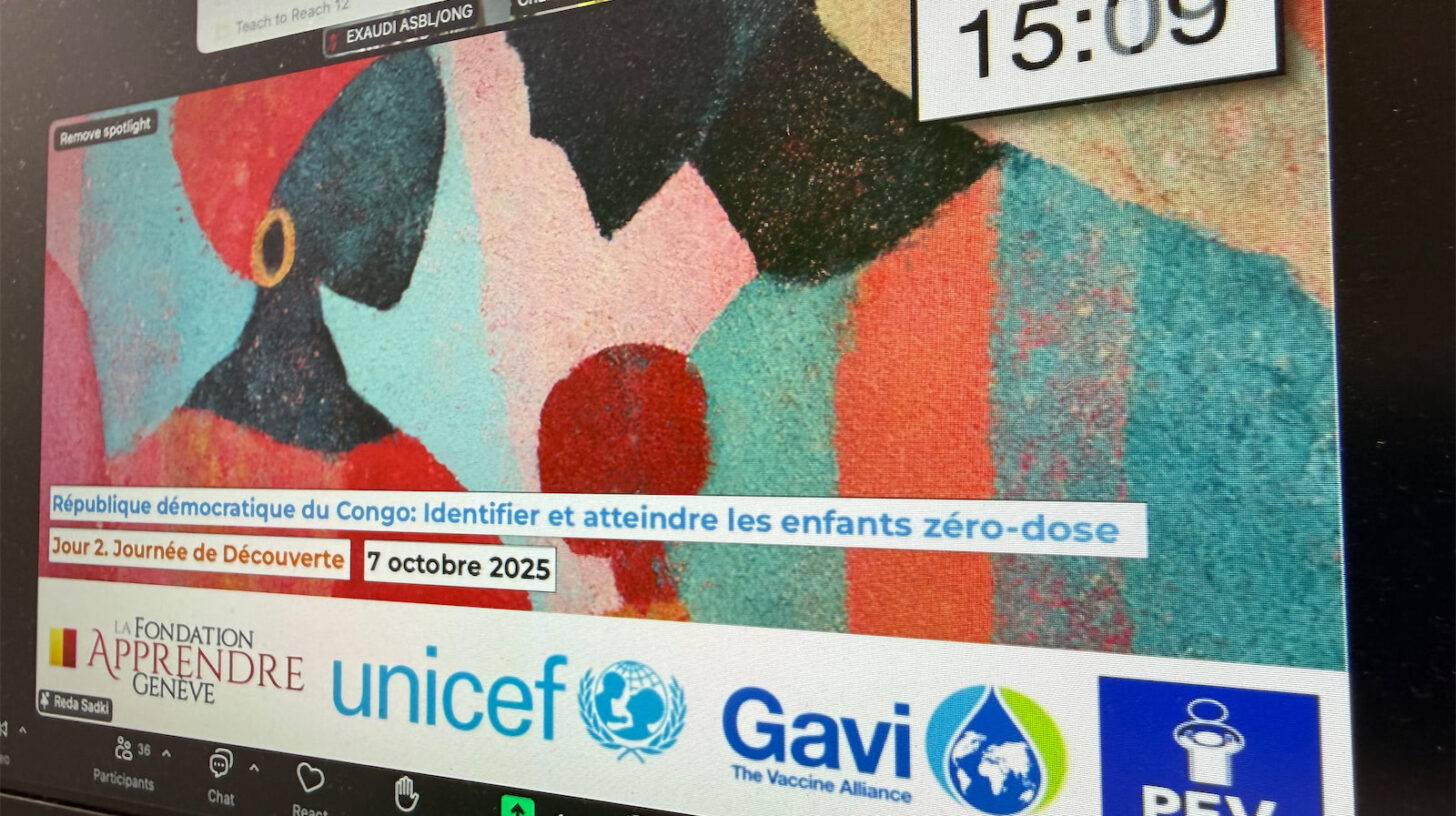
On the second day of their work together, health workers in the Democratic Republic of the Congo moved from discovering problems to digging deeper into why hundreds of thousands of children still miss out on vaccines that could save their lives. They found that the real reasons often hide in unexpected places: in fishing communities, in conversations with churches, or in camps where families flee from war.
When they looked more carefully, they found new ways to solve problems. The method they used turned health workers into problem solvers.
“Yesterday we found the problems. Today we went deeper. You have to dig,” said Fidèle Tshibanda Mulangu, one of the health workers from Congo. His words captured what changed on Wednesday, October 8th.
After the first day of sharing challenges, something shifted.
The goal was no longer just naming problems. Now they needed to understand exactly why those problems exist.
The Geneva Learning Foundation worked with partners—the Ministry of Health in the Democratic Republic of the Congo, UNICEF, and Gavi—to help participants use a root-cause method a second time.
The results came quickly.
“Yesterday I thought I had found the real reason. Today I learned it was only part of the reason,” said Hermione Raissa Tientcheu Ngounou. Her words showed how much deeper everyone was thinking.
When churches and health workers stop talking
In Kasai, one group looked again at Pentecostal churches that oppose vaccines.
This time they saw more than just a religious barrier. “When people in these churches get sick, they don’t come to health centers. They stay in prayer centers,” explained the group leader. This showed a broken trust with the health system.
When they dug deeper, they found the real problem: “There is no formal way for the health system and churches to talk to each other.”
The root cause was not faith. It was that no one had built a bridge between the two systems.
This insight led straight to solutions.
“Church leaders need to become our partners,” said Mwamialumba Fidel, one of the health workers.
Giving vaccines during war
In North Kivu, another group talked about vaccinating families forced to flee their homes.
They faced a cause they could not control: war.
But the health workers stayed practical. They did not give up.
The group found a specific problem they could fix.
“Children arrive without their vaccination cards. We don’t know how to add them to our regular vaccine program,” said Clémence Mitongo.
The root cause was no longer the war itself. It was “the lack of a clear plan for helping these children” once they reached safety.
The group changed an impossible problem into one they could actually solve.
Beyond borders, a lesson in local economics
The discussions became richer because health workers from other countries joined in.
One of the most powerful examples came from Madagascar. In one fishing village, 93 children had not been vaccinated.
“The women have to go with the men to sell the fish. By the time they get back, our vaccine teams have already left,” the group reporter explained.
When they dug deeper, they found the root cause had nothing to do with health care.
It was the lack of a smokehouse to preserve the fish. Without one, the women had to leave their children behind and travel to sell fresh fish.
This example made everyone stop and think.
“This case from Madagascar really shows us why we need to dig deep,” said Alphonse Kitoga.
Learning by doing
These real cases showed how fast the health workers were learning.
The “five whys” method, taught just the day before, was already a tool they could use on their own.
“This is a new way of working for us,” said Baudouin Mbase Bonganga. “Working in a group and sharing what we see in our own work has really helped us learn.”
The goal was not just to teach facts. It was to build a skill: helping each health worker become good at finding the real problems in their community and creating solutions that fit.
From analysis to action
This day of hard work was just the start.
The health workers have until Friday, October 10 to turn in the first draft of their field project. They will use what they learned to solve problems in their own communities.
This work shows that when field workers have the right tools, they can move fast.
Papa Gorgui Samba Ndiaye said it best: “This method helps us really understand the problems where we work. The good part is we don’t just copy answers from somewhere else… It pushes us to create new ones.”
The movement has started. And it is led by the people on the front lines every day.
Image: Peer learning exercise, as seen from The Geneva Learning Foundation’s livestreaming studio.