

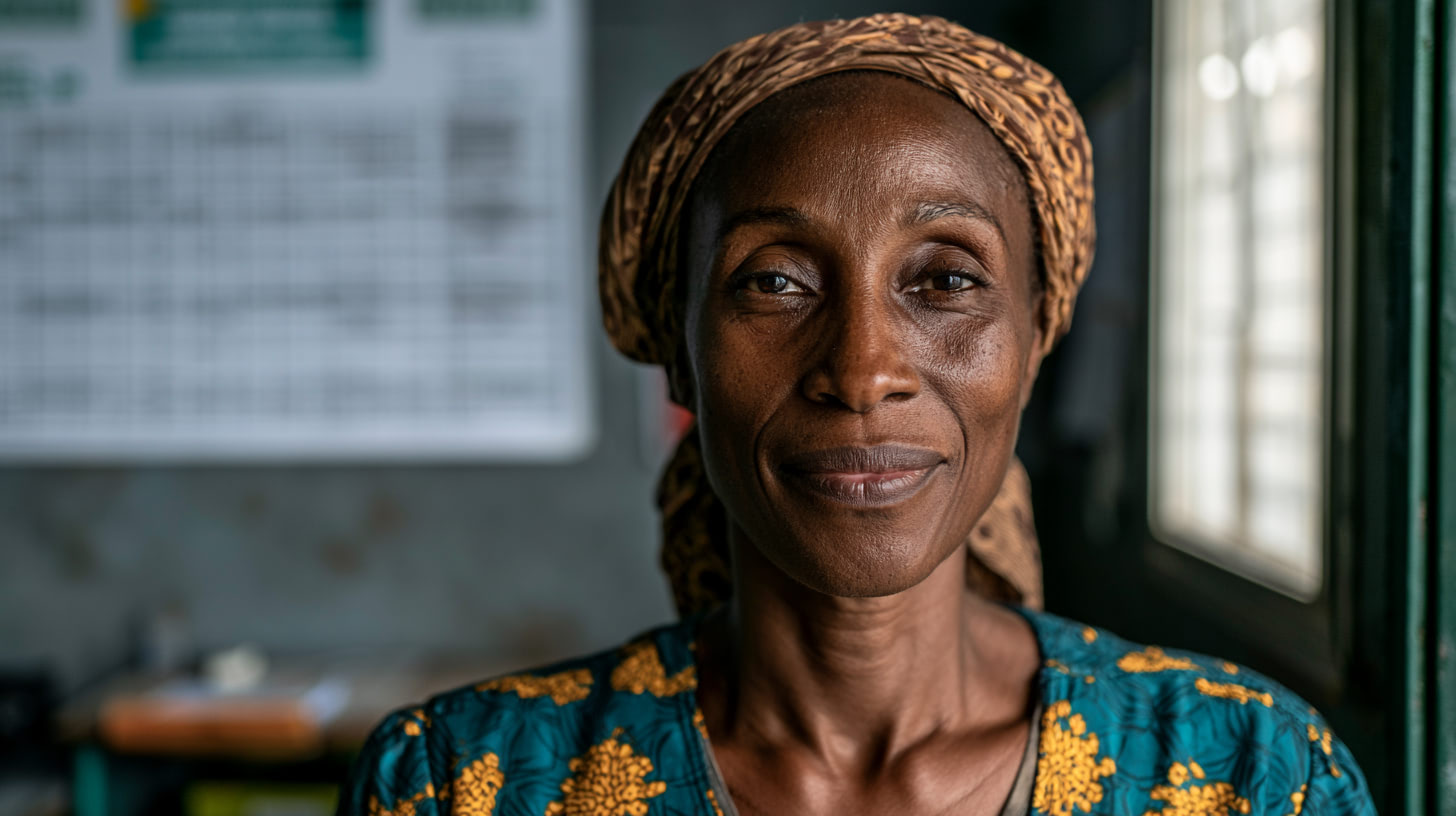
Manzama-Esso KOLA: the sociologist who learned to count vaccines
Manzama-Esso KOLA did not arrive at vaccination through medicine.
He holds a master’s degree in sociology and came to health work through HIV programming and Fonds Mondial.
When he became coordinator of Togo’s civil society platform for vaccination, a network of 39 organisations that covers the country and has supported the Ministry of Health on demand generation and communication since 2018, he was, by his own account, a newcomer to immunisation.
The TGLF data triangulation course, run with Jan Grevendonk at the World Health Organization (WHO) in 2019, changed his practice.
He had been receiving monitoring data from member organisations that was inconsistent and hard to act on.
After the training, he saw triangulation not as a specialist technique for evaluation experts but as a daily discipline for every dataset and every decision.
He produced a training manual and worked with the monitoring officers of his member organisations until the quality of their data improved.
The effect compounded.
With better data, KOLA and his platform could demonstrate their contribution more clearly.
With a stronger grasp of IA 2030 and Gavi programming cycles, they could write better proposals.
“We are now a well-recognised and well-consulted actor in vaccination,” he said.
The Division de l’immunisation, he noted, could confirm it.
KOLA tried to become a TGLF ambassador during the 2026 programme launch.
He was ill for two weeks during the four-week activation and could not complete the process.
His question at the reunion, asked respectfully but with visible frustration, was whether the programme would reconsider those who had started but not finished.
Reda Sadki explained that a new ambassador cycle would open in 2027.
KOLA accepted this.
His question itself captured something the statistics miss: the depth of investment that Scholars bring to this network, and the cost they feel when programme structures do not accommodate their circumstances.
Winiga KOUDEMA: from paediatrics to WHO, one certification at a time
Winiga KOUDEMA is a paediatric clinician by training.
He became a district health director, then a hospital director, without any formal preparation in epidemiology or public health management.
During the COVID-19 pandemic, a colleague shared a link to a TGLF Scholar programme.
The timing was precise: health systems everywhere were under pressure, continuity of services was at risk, and there was no time for formal courses.
What followed was incremental and cumulative.
The Scholar courses led Koudema to reorganise his team’s approach to vaccination logistics and cold chain management.
They prompted him to complete a postgraduate diploma in epidemiology.
The diploma and the Scholar certifications, listed together on his CV, opened a door to WHO consultancy work in polio and vaccination.
Further specialisation brought him to a permanent WHO staff position covering malaria and neglected tropical diseases.
A later organisational restructuring positioned him, as a paediatric clinician and epidemiologist, at the intersection where TGLF’s newest programme content lives: maternal and child health, reproductive health, neonatal care, and the health of people across the full life course.
He came to the reunion, he said, partly because the new responsibilities had caused him to drift from the Scholar community for a time, and he wanted to re-engage.
“With this meeting, this is an opportunity for me to truly re-launch myself.”
His comment about Togo’s National Malaria Data Repository, which will integrate climate, entomological, and routine data into a single system for the first time, was a reminder that his career trajectory has not moved him away from the field.
It has given him the tools and the position to influence how the field is measured.
Yamdi Kanou: the team lead who did not give up
Yamdi Kanou joined the Scholar network in July 2019, among the first wave of country groups formed when the accelerator launched at the same time across 24 countries.
He is a health engineer, assigned to the CHU Campus to manage the expanded programme on vaccination, and the programme found him mid-career, doing what he described as routine work.
The peer learning changed that.
He became country team lead for Togo.
He organised the scholars at national level.
He visited the Division de l’immunisation with the director to introduce the network to the hierarchy.
The effort met an obstacle he described with precision: the scholars were organised from the health facility level upward, while institutional coordination moves from the central level downward.
The two structures did not meet easily.
His path had interruptions.
A one-year field epidemiology training programme pulled him away from Scholar activities in 2022.
He applied for specific TGLF programmes and was not selected, which he attributed, perhaps correctly, to a preference for central-level applicants over peripheral-level ones.
“That discouraged me somewhat. But I did not give up.”
The phrase was not theatrical.
It was a matter-of-fact account of continuing through setbacks.
What the programme gave him is not abstract.
“On the ground, I find it easy now to communicate. I can convince parents who still resist today, to have their children vaccinated. I find myself quite at ease in the exercise of my profession.”
In a country where vaccine hesitancy is a documented and persistent challenge, this is a precise and practical result.
Kanma Nanah Tena: seven years, one commitment
Kanma Nanah Tena has been a Scholar since 2019.
She is chief of the communication section at the Division de l’immunisation and the person at this reunion who connected institutional responsibility most directly to what she had learned.
She worked on the immunisation equity analysis project and used the programme’s frameworks to develop field strategies for reaching zero-dose children and populations that are geographically or socially difficult to access.
She learned, through the TGLF courses, how to analyse plans of action against criteria grids.
“It really impressed me,” she said, “because with the criteria grids we received, it helped me, when we develop a plan of action, to really analyse whether everything is in the plan.”
She has shared every relevant learning with the national PEV focal point group.
She has tried, not always with success, to enrol colleagues.
She named the activation gap, 25 active members in a country with 791 registered scholars, as a problem and a responsibility.
She committed, in front of the room, to briefing the director of the Division at the start of the following week.
She committed to working with Kanou to reactivate the WhatsApp group.
She did not dramatise this.
She stated it as the next step.
The day ended with a group photograph, screens and chairs gathered into a single frame.
Tena was there, camera on.