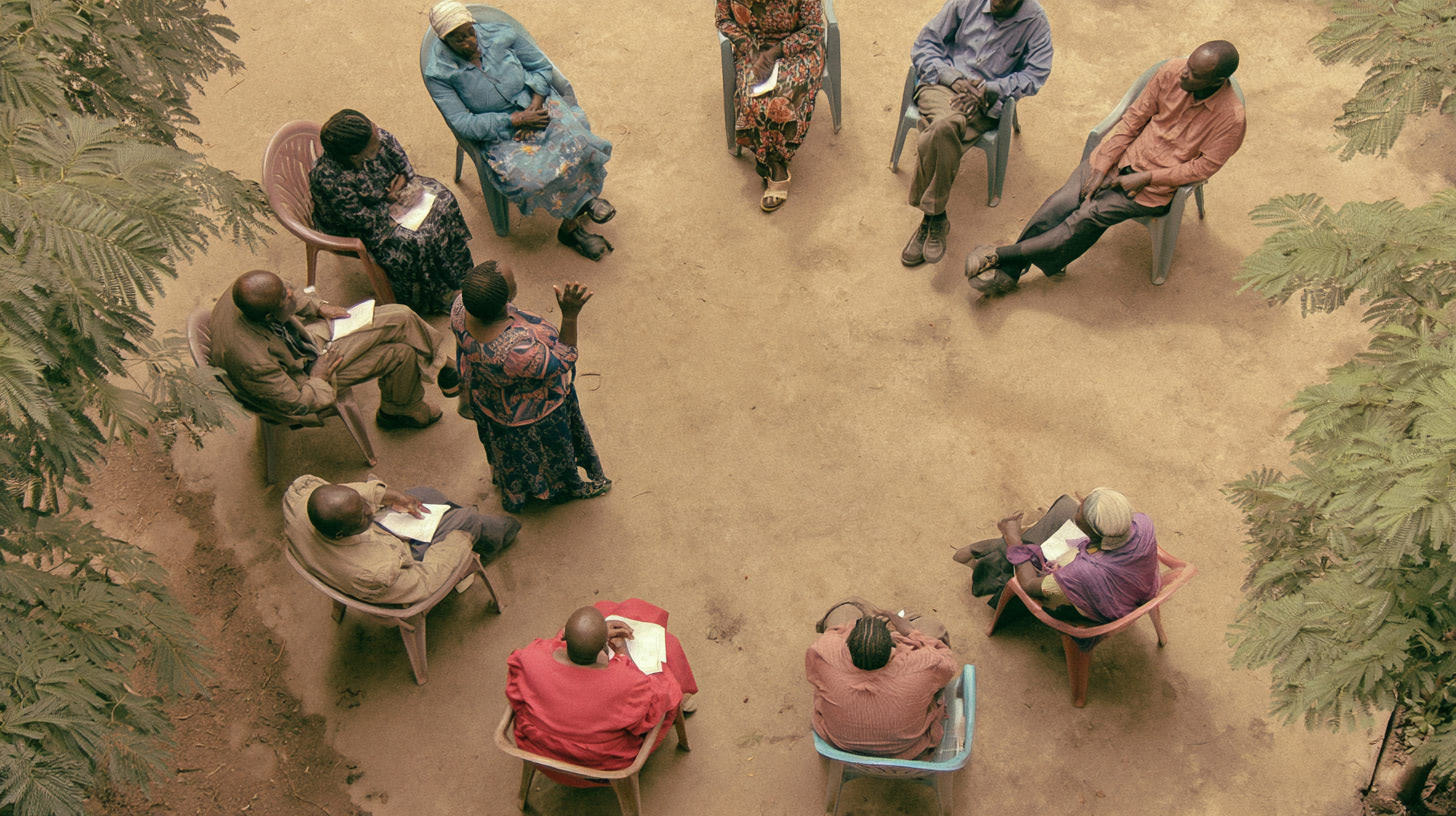
At Teach to Reach 15 on 2 July 2026, with health workers from over 60 countries on the call, The Geneva Learning Foundation paused its climate and health programme for ten minutes to hear from two health workers already inside the Bundibugyo virus disease response, one in the Democratic Republic of Congo and one in Uganda. This is the sixth and final article in the series from that convening. It leaves the climate frame to follow an acute outbreak, and it argues that what the responders and a TGLF Fellow described is a crisis of trust and behaviour as much as a medical one. What they said is worth reading closely. The next Teach to Reach, number 16, takes place on 6 August 2026.
Benoît Beya gave the room a number and then went quiet.
“Among health workers recently, we are at more than 17 doctors who have already died. More nurses have died from this outbreak.”
Read it quickly and it is a statistic.
Sit with it, and it is the response eating the people running it.
Benoît is a physician at Demba general hospital in Kasaï central, DRC, who worked the previous Bundibugyo response at Mweka and at Boulapé.
This time he described himself as an expert involved indirectly, and what he wanted the room to hear was not a plan but a plea.
“I advise everyone involved to respect infection prevention measures. And to protect themselves. Not just the affected population. Themselves too. So we can prevent these deaths that are shaking us.”
Seventeen doctors is Benoît’s figure.
He named it in the room.
The room did not challenge it.
Any reader who reaches the end of this article without hearing that number has not read the room.
An outbreak of Bundibugyo virus disease, part of the Ebola family, has been active in the DRC and Uganda for months.
The Foundation gave it 10 minutes of an event otherwise about climate and health, because on 2 July part of what the network knows is that a viral outbreak is moving through the same districts where the climate response is also playing out.
Benoît does what Charlotte Mbuh did at COP28 in the climate work.
He is not a demographer.
He is a physician who has been counting his own losses, and his authority to speak comes from where he is standing.
What Saidu Ainebyoona said, from Uganda
Saidu Ainebyoona joins the Foundation’s events from Uganda and works with the International Organization for Migration.
He is directly involved in the response on the Uganda side.
What he said had three parts.
One, the proper use of personal protective equipment is essential.
“It guarantees safety, and if everyone is taught how to use PPE and is supported with PPE, there is complete safety and the disease can be stopped.”
Two, the cases in Uganda are imported.
“Here in Uganda, the cases are usually coming from the DRC. There is the epicenter, and crossing the border to Uganda. These are communities that are interlinked. People will continue to move. So it is prudent that all the approaches are tailored to the community. There must be community accepted. One of the approaches we are using is to make sure that every step we take, the affected community is engaged.”
Three, decisions have to move faster than the disease.
“The disease spreads so quickly, so the decisions at every level must be done quickly, so that the approach reaches the ground before the disease spreads.”
Saidu’s three lines are what a working responder tells a colleague in a priority country.
They are not policy statements.
They are protocols in a hurry, and the hurry is the point.
What Panu Saaristo said, from a Fellowship built to do exactly this
Panu Saaristo, the Foundation’s first Fellow for Humanitarian Health and a veteran of Ebola responses at global and country levels, was invited to give the framing that binds Benoît and Saidu together.
“We need to see an outbreak like Ebola as a behavioural issue and a trust issue. If the approach is strictly medical, we are going to miss a big part of the dynamics of why we have the outbreak, why it continues to spread, why we do not get it under control, and why it perhaps immediately pops up again in the same locations.”
“Community trust is easily destroyed and difficult to build. Entering the communities with information about how you should change your behaviour, that is a trust issue. It needs to be approached from the trust building perspective and seen as such, and not as a question about how do I craft the most brilliant behaviour change messages. That will not bring the results we want unless we create the trust in the communities.”
Panu’s example was the one that comes up in every Ebola outbreak, the burials.
Rituals that carry family identity, community meaning, and grief, against a public health imperative that cannot be met with a slogan.
Why the trust argument is not soft
The reader hearing an experienced Fellow say trust is a trust issue may want that to be softer than the medical argument.
It is not.
The reason has to do with what trust actually predicts.
Trust is what determines whether a community accepts a burial protocol.
Trust is what determines whether a returning migrant tells the local health facility that a relative is unwell.
Trust is what determines whether a mother lets a stranger in a full-body suit approach her child.
Every one of those decisions is a data point a formal surveillance system either receives or misses.
The system’s data quality is downstream of the community’s trust in the responder.
The trust argument is about the entry conditions for the epidemiology.
The same argument runs through the eight climate-and-health findings, in particular the sixth: distrust built over years of unfinished external interventions cannot be solved in a week of crisis.
Bundibugyo is where the price of ignoring that finding shows up sharpest.
Where trust has eroded, the outbreak keeps returning to the same places, and the response keeps starting over.
What the network added
Tina Iroghama Agbonyinma, in Nigeria, sharpened the framing.
“Behavioural and trust issues are a community challenge. We will need to focus more on communication strategies and community engagement to end the ebola outbreak. Migrant communities should also be a key focus.”
Dr Akhtar Muhammad Islam Jar, in Afghanistan, wrote in about the part that binds Bundibugyo to any outbreak that displaces people.
“During difficulties in evacuating patients, we need more community engagement to support the vulnerable, especially women and children, to evacuate to health facilities.”
Jellisters Debitha, a community health worker with the Kenya Malaria Youth Corps, connected that to her own East Africa work.
“Dr Akhtar’s mention of the immense difficulties in evacuating vulnerable women and children really struck a chord. We cannot build climate resilience without directly integrating local community engagement into our emergency health logistics.”
Sarah Nambudye, in Uganda, added the community perception clinicians must reckon with.
“In Uganda, especially in the rural areas, the community says IRS, indoor residual spraying, is ineffective.”
Indoor residual spraying is a malaria intervention, and Sarah’s observation holds for Bundibugyo too.
An intervention a community reads as ineffective is, from a trust standpoint, worse than no intervention at all.
Reading the three named voices together
Benoît speaks from the epicentre.
Saidu speaks from the receiving side of the same border.
Panu speaks from twenty years of doing this at global level and knowing where the mistakes get made.
The overlap in what they said is where a reader in a priority country can act.
PPE, absolutely, and do not stop there.
Community engagement is the practice, not the polish.
Trust is measured, built, and maintained, and it is the substrate the whole response sits on.
Decisions have to move as fast as the disease, which means the authorisation to improvise has to be given in advance, not requested during.
Health workers are dying, and barrier measures are the reason Benoît came to the room to speak.
What the response system is actually being asked to do
The skeptical epidemiologist would frame the wider point as a question about evidence hierarchies.
Should we not rely on the modelling, the seroprevalence surveys, the case counts?
Are three testimonies really the strongest evidence in the room?
All of these forms of evidence carry weight, and none is complete.
The modelling tells you what to expect.
The surveys tell you what has already happened.
The testimonies tell you what the workers in the middle are actually doing, which is the part the modelling and the surveys cannot capture.
In the terms of Reda Sadki’s essay on anecdote or lived experience, the health worker’s account is a signal about local conditions the formal system might take years to detect through conventional surveillance.
Testimony does not replace surveillance.
A response designed only from the surveillance is a response designed with half the picture.
The Foundation opened a peer learning course on Bundibugyo virus disease at the same event, in both languages, because the other half of the picture has to come from workers already inside the response, who need a place to compare notes before the next patient arrives.
What the Fellowship is for
Panu Saaristo was named in May 2026 as the Foundation’s first Fellow for Humanitarian Health.
The Fellowship exists so the network has access to the analytical framing a working responder needs during an outbreak, without having to build it from scratch every time.
He can hold Benoît’s figure and Saidu’s three tips inside a framework built from prior outbreaks, and hand that framework to a colleague in a priority country in under two minutes.
That is the middle layer again, in a different shape.
Not the ministry, not the field, but the practitioner-strategist who can speak to both.
The climate-and-health work has been describing that layer for three years.
On 2 July, at Teach to Reach 15, Bundibugyo showed what it looks like when it is working, and it opened with a man counting the doctors he has lost.
[…] Ten minutes, three responders, and the argument that keeps outbreaks coming back to the same village… […]