What changed at Teach to Reach 16?
On 6 August 2026, at Teach to Reach 16, health workers from more than 50 countries joined the sixteenth edition of the world’s largest peer learning…
Featured
On 6 August 2026, at Teach to Reach 16, health workers from more than 50 countries joined the sixteenth edition of the world’s largest peer learning…
In online learning, 95 people out of a 100 quit. A network of health workers from malaria-endemic countries spent one summer proving that this is a…
What do a rapid test, a preventive medicine, and a bed net have in common? Every one of them, somewhere, has met a parent who said…
You are stuck on a problem at work. A colleague in another country has already solved it. How can you connect? Request your invitation to join…
The Geneva Learning Foundation runs peer learning for the people who deliver health care where it is hardest to deliver. Its courses ask participants not for…
258 health workers. 1,534 real stories. One question: how do we turn the tide against malaria? In Teach to Reach 16, the Geneva Learning Foundation gives…
Latest
This is my presentation at the Online Learning Summit in London on 16 June 2015. I asked participants to choose between a set of four questions:…
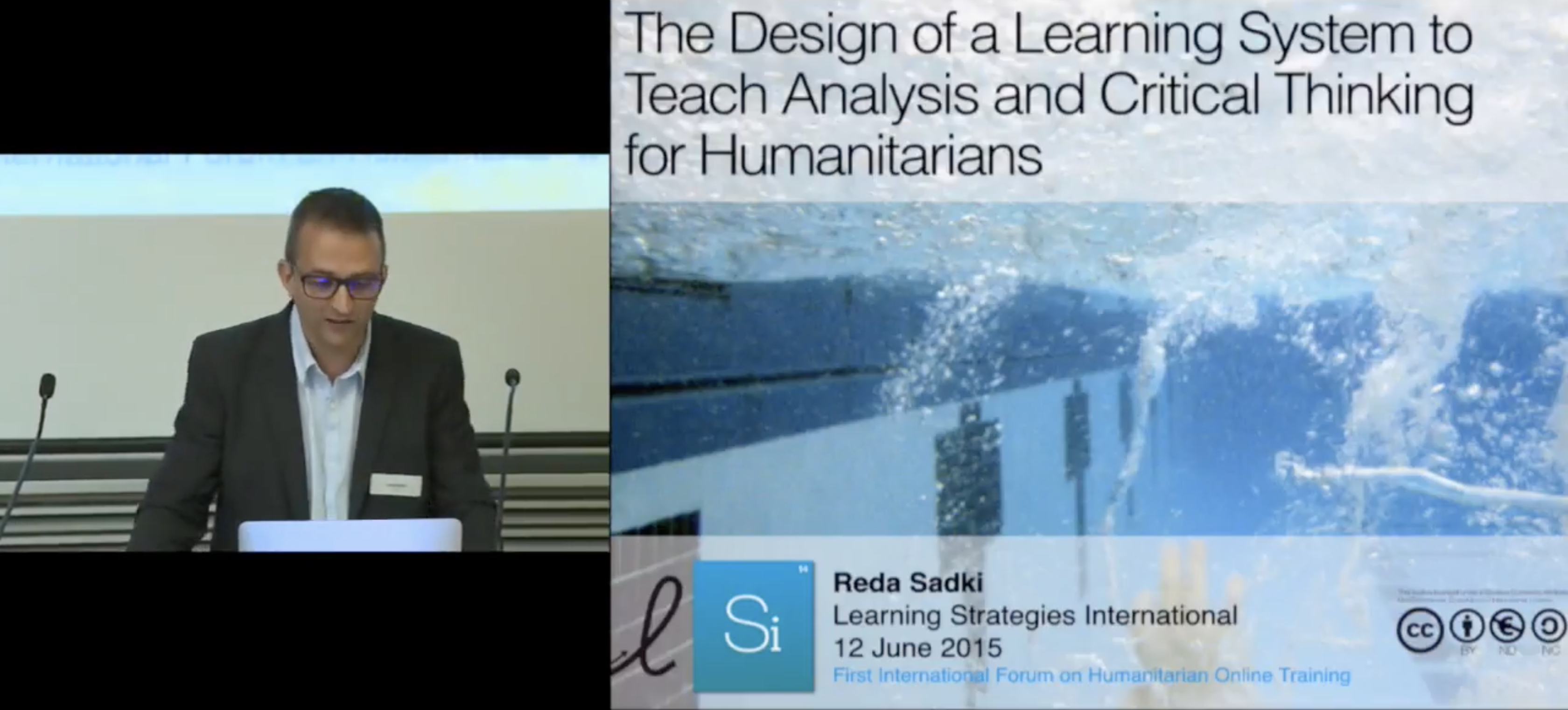
This is my presentation at the First International Forum on Humanitarian Online Training (IFHOLT) organized by the University of Geneva on 12 June 2015. I describe some…
Experience is the best teacher, we say. This is a testament to our lack of applicable quality standards for training and its professionalization, our inability to act on what has consequently become the fairly empty mantra of 70-20-10, and the blinders that keep the economics (low-volume, high-cost face-to-face training with no measurable outcomes pays the bills of many humanitarian workers, and per diem feeds many trainees…) of humanitarian education out of the picture.
My presentation at the First International Forum on Humanitarian Online Training (IFHOLT) hosted by the University of Geneva on 12 June 2015. A more detailed version of…
Even as computer-mediated communication is now embedded into nearly every aspect of life, the sentiment persists that written and therefore distance communication is intrinsically inferior. Here is the…
We are both consumers and producers of publications, whether in print or online. Publications are static containers for knowledge from the pre-Internet era. Even if they…
Webinars reproduce the structure and format of the formal training workshop in an online space. The sole positive distinction for participants is that they may now…
Where phone and Skype remain the gold standard for one-to-one communication (and learning), many of us find value in conference calls, irrespective of the technology (phone,…
Of the myriad technologies in use, we may find it useful to focus our attention on those that (1) are now widely used, to examine their…