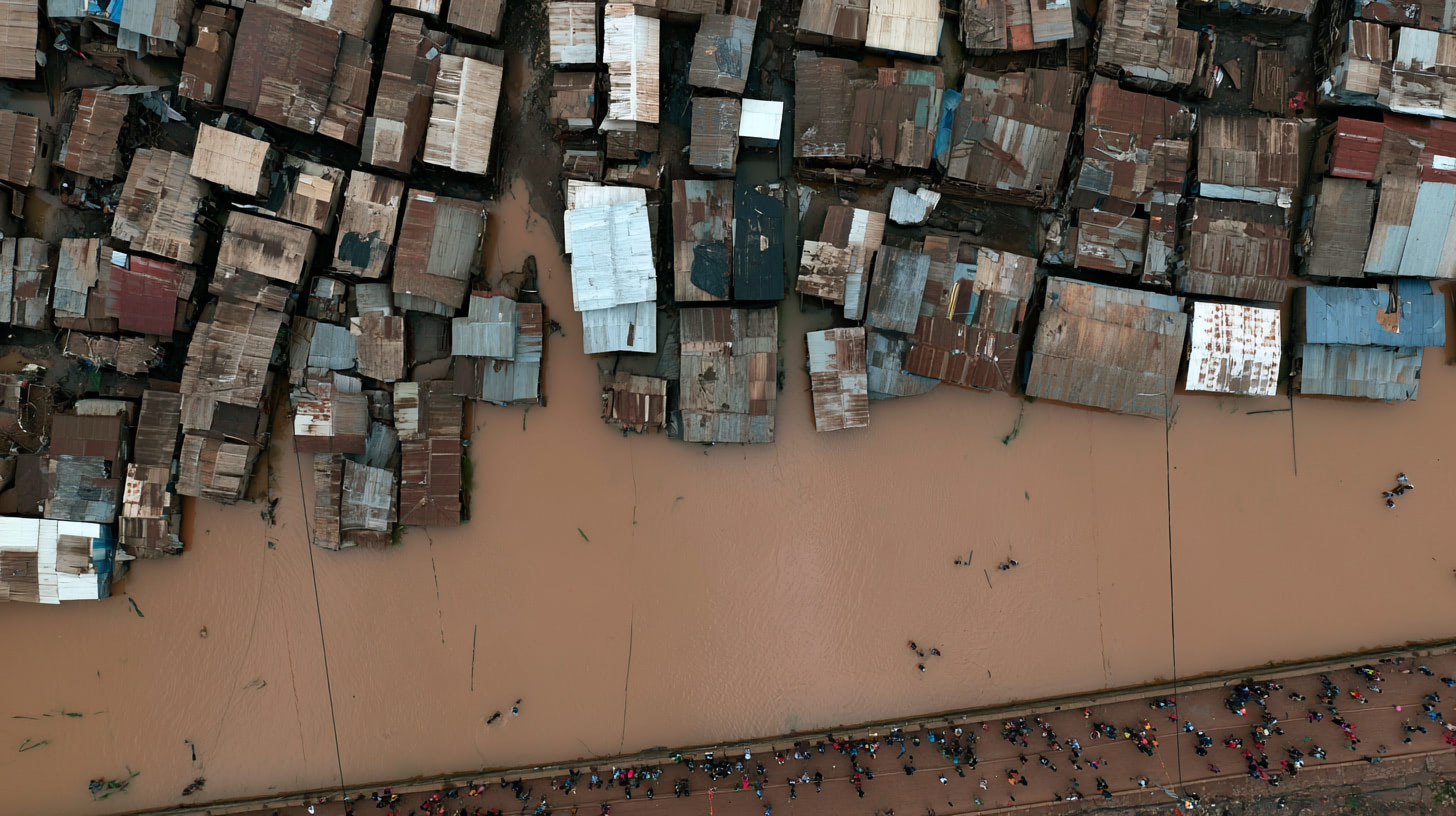
Teach to Reach 15, held on 2 July 2026, brought together health and humanitarian workers from over 60 countries around a single act: The Geneva Learning Foundation read back to them what more than a thousand of their peers had reported about the climate crisis and their communities. This is the fourth article in a series of six from that convening. Having heard the voices and looked closely at one solution, this article asks a system question: who sees a climate emergency first, and what happens because they are the ones who see it. The answer, repeatedly, is the health worker who was already there when the water came in. The next Teach to Reach, number 16, takes place on 6 August 2026.
Lillian Mutua did not describe a flood the way a meteorologist would.
She described a maternity ward with water on the floor and a filing cabinet of lost registers.
“We lost more than 100 people in the central business district,” she told a room of health workers on 2 July, counting Nairobi’s dead from a single episode of short rains.
Then she kept counting, past the fatalities, into the part of a flood that only a health worker sees.
Sewage backed up into the clean water.
Households with chronic patients could not salvage their medicines or their appointment cards.
The health facilities themselves went under, and with them the paper records that hold a community’s vaccination and antenatal history.
“Climate change is real,” she said, “and the communities are realising what the impacts are.”
Mutua was one voice in a session that The Geneva Learning Foundation (TGLF) built around a single act: reading back to health workers what more than a thousand of them had reported about the climate crisis and their communities.
The accounts came from a peer learning process that has been gathering the experiences of frontline workers for nearly three years.
What the reading made plain is something the global conversation keeps missing.
Health workers are not waiting to be told that climate change is a health emergency.
They are treating its casualties, and they have started rewriting how they work.
They see it first, because they are counting the bodies
Ask where the early warning system for climate and health lives, and the honest answer from this session is that it lives in the observations of people like Mutua, Deepanjali Shrestha, and Kaiser Parvez.
Deepanjali Shrestha, retired from a career in health in Nepal, has watched dengue move house.
“Before it used to be in the hill region,” she said, “but now it is in the central region also.”
That is a range shift, the kind of signal that takes a surveillance system years to confirm, stated in one sentence by someone who has treated the fevers in both places.
In Riyadh, Kaiser Parvez listed what a 50-degree afternoon does to the people who build the city in it: dehydration, sunstroke, the collapse of outdoor workers.
None of these are new diseases.
They are familiar problems arriving harder, earlier, and in places they used to spare, which is the pattern the Teach to Reach report identified as the first key finding: climate change is making known diseases worse rather than inventing new ones.
The point is not that these workers have anecdotes.
The point is that they have the earliest reliable read on what a changing climate is doing to human health, and they have it because they are the ones in the ward when the water comes in.
What they do with what is in the room
The session’s centre of gravity was ten local solutions, each one a line a health worker had written and Charlotte Mbuh read aloud.
None of them involved a programme, a grant, or an external team.
In Taraba State, Nigeria, Habila Kushana Habu could not reach flooded villages, so he borrowed boats.
“These boats were borrowed from local fishermen who generously offered their assistance,” he reported, and on those boats went immunisations, antenatal care, and malaria and diarrhoea treatment.
In Kolda, Senegal, Malick Ndome watched floods destroy the tracks that women used to reach antenatal appointments, so he put phones in the middle.
Midwives gave advice down the line to women in labour they could not yet reach in person.
In Kavumu, in the DRC, a community bought a plot of land and built its own health centre to close the distance to care.
These are not stopgaps that the formal system tolerates.
They are the formal system, running on improvisation it does not name.
The report drew that out as its second finding: the first response to a collapse in access is always local, and the official response depends on it.
Tina Iroghama Agbonyinma said as much when Reda Sadki asked what surprised her about the ten solutions.
Nothing, she answered.
“This is part of our daily work as field workers. Local solutions are the first step that every health worker provides, before the state and national teams come in.”
The bill nobody is reading
The finding that unsettled the facilitators most was not about ingenuity.
It was about who pays for it.
Across the accounts, the money keeping services alive during climate shocks is coming out of the workers’ own pockets, government staff included.
A midwife in Tarime hires the motorbikes that carry her to patients.
A worker in Ho West, Ghana, spends four days travelling between communities and absorbs the cost.
Community savings groups quietly function as the health insurance that formal insurance never reached.
The Foundation’s blunt instruction to workers reads, in this light, less like advice than like an audit: record what you spend out of pocket, because a cost nobody counts is a cost nobody reimburses.
Read against TGLF’s new leadership framework, these accounts stop looking like scattered acts of goodwill.
Mutua’s plan to map hotspots, resources, and decision makers before the next flood is situational awareness written as procedure.
Habu borrowing the fishermen’s boats is the capacity to act inside a hard constraint.
The women’s groups financing safe births are relationships built long before the emergency that needed them.
The framework does not describe skills these workers should acquire.
It describes what they are already doing, at a cost they are already paying, in a fight they did not choose but refuse to lose.
[…] Three people who saw it before the data did. […]
[…] Trois personnes qui ont vu venir les choses avant les données. […]