
By Panu Eskola Saaristo, TGLF Fellow for Humanitarian Health

Two reports published within a year of one another describe the same emergency from opposite ends.
The 2025 Lancet Countdown, now in its ninth year of annual indicators, measures the hazard, and the numbers are past arguing with: heat-related mortality up 23% since the 1990s, an annual average of 546,000 deaths, a record 154,000 deaths from wildfire smoke in 2024.
The Johns Hopkins Center for Humanitarian Health–Lancet Commission, launched in Geneva in May, finds the system built to respond no longer capable of protecting lives at the scale required, and sets out what would replace it.
Neither is about clinical practice, yet both leave clinical practice better equipped than it was: one with a hazard picture precise enough to act on, the other with a reform agenda that treats climate resilience as structural rather than optional.
What they land on is a question.
What is supposed to happen at the moment a patient walks out of a health facility?
How is any of this meant to fit into a working day?
It is not, unless we who work in the clinical setting start somewhere narrow.
Take one point in the care journey
So take one point in the care journey, the most fragile, the one where most can go missing.
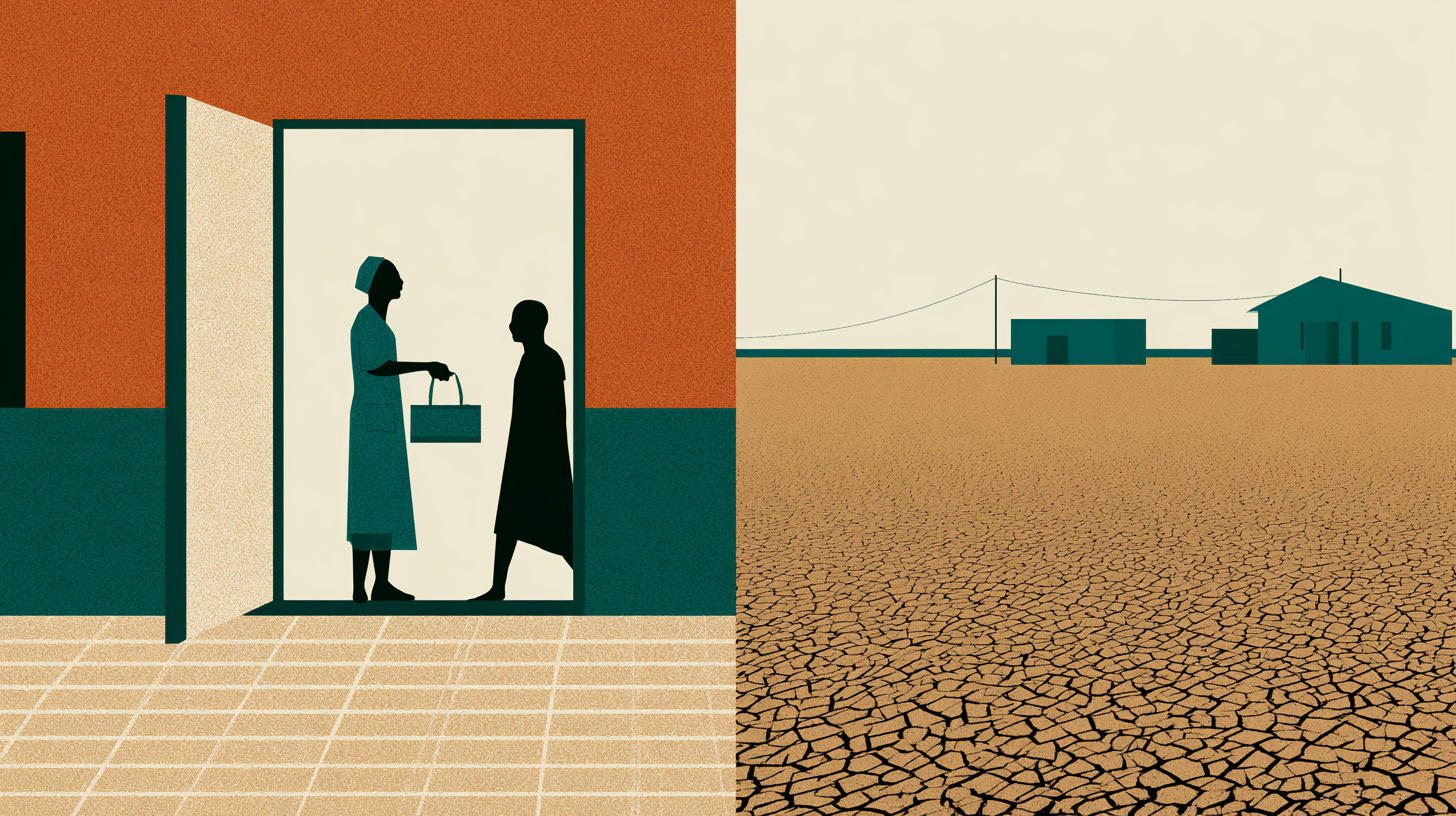
That is the discharge, the moment doctors and nurses take their hands off and responsibility passes to the patient, often in the hope that some network exists to catch it.
Observation, equipment, a secured cold chain, a colleague down the corridor, electricity.
All of it stops at the exit door.
The plan is expected to carry on without any of it, and we have somehow decided this is the uneventful part of the care journey, like a checkout from a B&B.
A patient is stable, the treatments and care have been correct.
The regimen assumes cold storage of the medicines.
What happens outside the facility matters for the facility
However, the household is about to lose power for three days in 40°C heat.
Whether the medicine survives is the obvious question.
The one easier to miss is whether anyone in that household, after three nights without sleep in that heat, will notice that it has not survived.
The Lancet Commission’s most useful finding for anyone working at that exit door is that between 70 and 90% of excess deaths in many conflicts arise indirectly, through the collapse of health services and the systems around them, which is to say away from the bedside and after the encounter, exactly where climate risk accumulates as well.
Funding versus reality
Nobody in this sector needs telling that money is short.
Posts are being cut, programmes closed, appeals revised downwards halfway through implementation, and 239 million people are expected to need humanitarian assistance in 2026 while 87 million have been prioritised to receive it.
That shortage is real where the work is done.
It is also produced somewhere else, and the figures for that are not obscure.
USD 23 billion would meet the world’s most urgent humanitarian needs, under 1% of what is spent annually on armed forces.
Governments put USD 956 billion into net fossil fuel subsidies in 2023.
Within climate and health, whatever survived those decisions has gone into knowing rather than doing: 97% of cities reporting to the CDP have completed a climate risk assessment or intend to do so.
Assessment is nearly universal now.
What follows assessment is measured much less closely.
The Commission has done the groundwork for this.
It requires climate resilience in health systems transformation from the outset, naming infrastructure, supply chains and service delivery models, and it lists anticipatory financing among the instruments that would stabilise humanitarian funding.
Readiness versus preparedness
All of that describes what a system holds in readiness.
Readiness turns into an intervention in a decision taken about one person, and that step belongs to clinical staff.
The moment of discharging a patient is not the only candidate for where to begin.
Someone will make the case for triage, or for the follow-up appointment.
I would still start at the discharge.
A forecast can say that the temperature will hold above 40 degrees for a week.
It cannot say which household has no shade, who will be alone between 08:00 and 18:00, or whose neighbour has the only working generator.
The network hoped for at the discharge does exist, and it already holds that knowledge.
Community health workers have it.
So do outreach teams, which in many places are organised by community-based organisations with volunteers rather than employees of anything.
So do congregations, women’s groups, neighbourhood associations, and the improvised digital messaging groups that people put together whenever they need.
So, most of all, do patients and their families.
Information flows, but for whom?
The information flow downwards is organised.
The forecast reaches the authorities and the authorities reach the facility.
What moves any other way depends on who happens to take the initiative.
Inward, from the community to the clinic, there is knowledge that would change a discharge decision, and asking for it is rarely anyone’s defined responsibility.
Upward, what a nurse notices when a patient leaves could inform the next adaptation plan, and the route it takes is slow: compiled at a meeting, carried to a second meeting, tabled at a third, arriving as system-wide knowledge some weeks after the heatwave it described.
Across, a nurse who has worked out what to ask before sending someone home in a heatwave can usually find a nurse facing the same thing three districts away, and it is that second nurse, not a guideline, who is likely to have the answer.
Those lateral routes are largely informal, and informality is what makes them fast.
The oddity is how readily they get hedged about, so that the quickest traffic in the system moves semi-privately while the slow route is the one with a budget line.
What gets counted is provision, meaning how many institutions teach climate and health.
What colleagues work out and pass to each other is barely counted at all.
What does ‘inverting the power’ mean?
Invert the power, says the Commission’s first recommendation.
Take it seriously and it applies to knowledge as much as to governance and funding, because power moved while information keeps travelling one way rebuilds the arrangement it was meant to replace.
The connection has to be made deliberately, in both directions, rather than left to a defensive reading of rules that were never about this.
None of this is a further duty for overstretched staff.
The organisation monitors the threats, turns warnings into clinical triggers, writes protocols that can actually be used and resources the referral pathways, and it owes a channel running the other way.
Stable at discharge is not enough where a stable home, uninterrupted services and reliable follow-up cannot be assumed.
The standard has to be whether a person can stay safe in what they are going back to.
Everything has changed, but nothing is new
None of this is new.
The 1948 definition, complete physical, mental and social well-being, has stood for nearly eight decades without amendment, and it describes a moment.
It names neither the risk of ill-health nor the risk factors that produce it.
Huber and colleagues proposed in 2011 that health be understood instead as the ability to adapt and self-manage.
Applied to a warming climate that asks nothing more of patients, and I would push it further than Huber does.
Adaptive capacity is not something only a person has.
It sits between them and their context, their household, the power supply, the neighbour with the generator, the people who would notice they had gone quiet: the community.
We can already say what the heat will do to that household in three days’ time.
Nobody has been made responsible for saying it.
References
- Huber, M., Knottnerus, J.A., Green, L., van der Horst, H., Jadad, A.R., Kromhout, D., Leonard, B., Lorig, K., Loureiro, M.I., van der Meer, J.W.M., Schnabel, P., Smith, R., van Weel, C. and Smid, H. (2011) ‘How should we define health?’, BMJ, 343, d4163. doi:10.1136/bmj.d4163.
- Romanello, M., Walawender, M., Hsu, S.-C., et al. (2025) ‘The 2025 report of the Lancet Countdown on health and climate change: climate change action offers a lifeline’, The Lancet, 406(10521), pp. 2804–2857. doi:10.1016/S0140-6736(25)01919-1.
- Spiegel, P., Martinez, E., Abrahim, O., Undie, C.-C Altare, C., Schmid, B., et al. (2026) ‘Johns Hopkins Center for Humanitarian Health–Lancet Commission on health, conflict, and forced displacement: health in a world of crises and impunity’, The Lancet, 407(10543), pp. 2065–2140. doi:10.1016/S0140-6736(26)00564-7.