
This Rapid Gender Analysis was produced by the TGLF Insights Unit on 25 August 2026.
How to cite: The Geneva Learning Foundation. (2026). Rapid Gender Analysis: Floods and Landslide, Fako Division, South-West Cameroon, August 2026 (Version 1.0).
Learn more about The Geneva Learning Foundation’s Gender in emergencies programme.
Gender in emergencies: learn, take action, and get certified
Share your experience and learn from colleagues about gender in emergencies. Learn more and enrol in this certification from The Geneva Learning Foundation: EQUITY-002 Gender in emergencies: a rapid introduction
Objective
The DREF operational plan for Fako states that “a gender analysis will be carried out at the outset.” At publication on 20 August 2026, none existed (DREF Operation MDRCM045). This document supplies an interim evidence base so that decisions taken in the next three weeks are not taken blind. It goes deepest on two areas the DREF funds but does not specify: gender-based violence referral, and water, sanitation and hygiene.
A. Executive summary
A pregnant woman and two other women died in the Limbe landslide on 5 August 2026. The operation responding to their deaths has no obstetric referral pathway, no menstrual hygiene objective, and no child safeguarding policy (DREF Operation MDRCM045).
Gender appears throughout this response on paper. The DREF publishes a sex- and age-disaggregated target, prioritises women-headed households in its targeting criteria, funds 1,484 dignity kits, and budgets CHF 36,705 for protection, gender and inclusion. What it lacks is a referral system to receive the cases those activities will surface. The protection referral circuit is still being built while distribution starts.
Readers can save themselves most of the work in this document by reading the March 2023 Buea assessment alongside it. Buea sits in the same division, roughly 20 kilometres from Limbe, and was hit by the same hazard three years ago. UNFPA and Gender-Based Violence Area of Responsibility partners recorded there what women lost, what they needed, and which interventions worked (UNFPA Buea assessment). Every pathway in that assessment has a direct analogue in Fako today.
What the response teams need to know
- Three women died, including a pregnant woman who lost her unborn child. The one man in the house survived and remains in intensive care (DREF Operation MDRCM045).
- The referral system does not exist yet, and distribution has started. The DREF funds “implementation of protection/PSEA referencing circuit,” and targets referral of 30% of identified cases (DREF Operation MDRCM045).
- Three safeguarding policies are missing as cash and kits start moving. The National Society has a prevention of sexual exploitation and abuse policy, but no child safeguarding policy, no whistleblower protection policy, and no anti-sexual harassment policy, and the child safeguarding risk analysis for this operation is incomplete. CHF 219,171 in cash goes to 500 households and 1,484 dignity kits to women and girls (DREF Operation MDRCM045).
- Latrines and waterpoints are where women get hurt after a flood in this division. In Buea, destroyed latrines forced women and girls to ask neighbours for access, described as very challenging at night, and broken pipes made menstrual hygiene management a stated problem. Fako’s WASH budget of CHF 30,896 lists kits and water treatment tablets, naming neither issue (UNFPA Buea assessment; DREF Operation MDRCM045).
- The hillside eviction order carries protection consequences. The Prefect has ordered people off the slopes above Limbe. In Buea, demolition in the risk zone pushed families into host households and open-air sleeping, and the safety audit then found gender-based violence cases inside those host populations (DREF Operation MDRCM045; UNFPA Buea assessment).
- Nobody from the affected community sits on the body running this response. The Fako Departmental Committee is chaired by the Prefect and includes the town hall and territorial administration, with no women’s organisation or civil society representative (DREF Operation MDRCM045).
- Women in Fako are already responding, and already underfunded. Local women-led organisations operate in this division, and AMEF staff described on record in 2023 the barriers they face reaching humanitarian money (Interview with Theresia Ngoe, UN Women).
Where this sits in the chronology
Onset was 5 August 2026. The DREF was allocated on 20 August and runs to 31 January 2027. This analysis was produced on 25 August, three weeks after onset, from sources published between December 2020 and 21 August 2026. It builds on no earlier gender analysis for this event, because none exists. The DREF’s own gender analysis, once co-authored with local organisations, and the first post-distribution monitoring round should both supersede what follows. Recommendation 2 sets out how.
B. Findings
Scale, and a disagreement worth keeping open
Torrential rain struck Limbe on the night of 5 August 2026, triggering flash floods and a landslide in the Mbende and Gardens neighbourhoods. By 8 August, more than 1,500 households, roughly 12,000 people, were affected, with several neighbourhoods still under water (DREF Operation MDRCM045). A government assessment led by the Fako Senior Divisional Officer found six houses collapsed across Mbende and Busumbu, alongside damage to roads, bridges, and the fence of the Limbe Wildlife Centre (Cameroon Tribune). On 13 August the Minister of Territorial Administration distributed presidential relief to 500 flood-affected families, including rice, sardines, cooking oil, soap, buckets, blankets and mattresses (Human Rights and Legal Research Centre).
Two counts of this event disagree. A global hazard-monitoring platform recorded 3 deaths and 100 people displaced for 4 to 6 August, classifying the event as low-to-moderate (GDACS Flood Event FL 1104078). The Red Cross reported roughly 12,000 affected by 8 August. The observation windows differ, and displacement and affected measure different things, but the gap is wide enough that an actor planning against the lower figure would under-resource badly. A flooding and rescue event reported in Kumba, Meme County on the same date has also not been reconciled with the DREF figures (BaretaNews).
Demographics: better than usual, with two axes worth using
The operation publishes a sex- and age-disaggregated target population of 4,579 women, 1,781 girls under 18, 4,343 men and 1,297 boys under 18, from 12,000 people targeted, with an estimated 16% living with disabilities and the entire caseload classified as urban (DREF Operation MDRCM045). Reporting against this breakdown is therefore a matter of discipline rather than data collection capacity, since the DREF also commits to Kobo Toolbox collection disaggregated by sex, age and disability. The disability and urban figures give two axes cutting across sex. A systematic review of intersectionality in climate and agriculture work concludes that without considering social variances between and within genders, programming lacks comprehensive insight into differential impacts (African Journal of Gender, Society and Development). A woman with a mobility impairment in a hillside neighbourhood facing eviction needs something different from a plan built for “women.”
Two figures are missing. No sex-disaggregated count exists for the affected population as distinct from the targeted population, and no count exists of pregnant or lactating women. The 1,484 dignity kit figure derives from household ratios, 53% of members being women and 70% of those of childbearing age, rather than a field count (DREF Operation MDRCM045).
What the same hazard did to women 20 kilometres away, three years ago
On 18 March 2023, torrential rain and mudslides struck Buea, also in Fako, killing two people and leaving over 1,100 homeless. A rapid assessment and safety audit by UNFPA and Gender-Based Violence Area of Responsibility partners found most affected households were women-led (UNFPA Buea assessment). This is the closest detailed gender-disaggregated dataset available for this hazard in this division, and it forms the analytical backbone of what follows.
| Impact domain | Documented in Buea, March 2023 | Status in the Fako 2026 plan |
| Livelihoods | Women predominantly ran the small businesses around the affected houses; many left with nothing while providing for children | Targeting prioritises women-headed and unemployed-head households / no livelihood restoration component |
| Water and menstrual hygiene | Many waterpoints destroyed and supplying pipes broken; menstrual hygiene management a stated challenge | 500 WASH kits and 60,000 water treatment tablets funded / menstrual hygiene not named as an objective |
| Sanitation and night safety | Latrines destroyed, obliging women and girls to ask neighbours for access, very challenging at night | No latrine reconstruction line |
| Shelter and displacement | Demolition in the risk zone forced relocation to hosts or open-air sleeping | Hillside eviction injunction issued / no shelter or relocation component |
| Gender-based violence | Safety audit revealed several cases perpetrated on women, girls and children within the host population | 30% referral target / referral circuit still being built |
| Sexual and reproductive health | Women, including pregnant women, lacked resources to reach care; referral to a named hospital with a seconded midwife | 1,484 dignity kits / no obstetric or antenatal pathway |
| Mental health | Socioeconomic loss produced distress; women reported fear for their daughters’ futures | Two psychologist volunteers for 10 days, 100 people targeted |
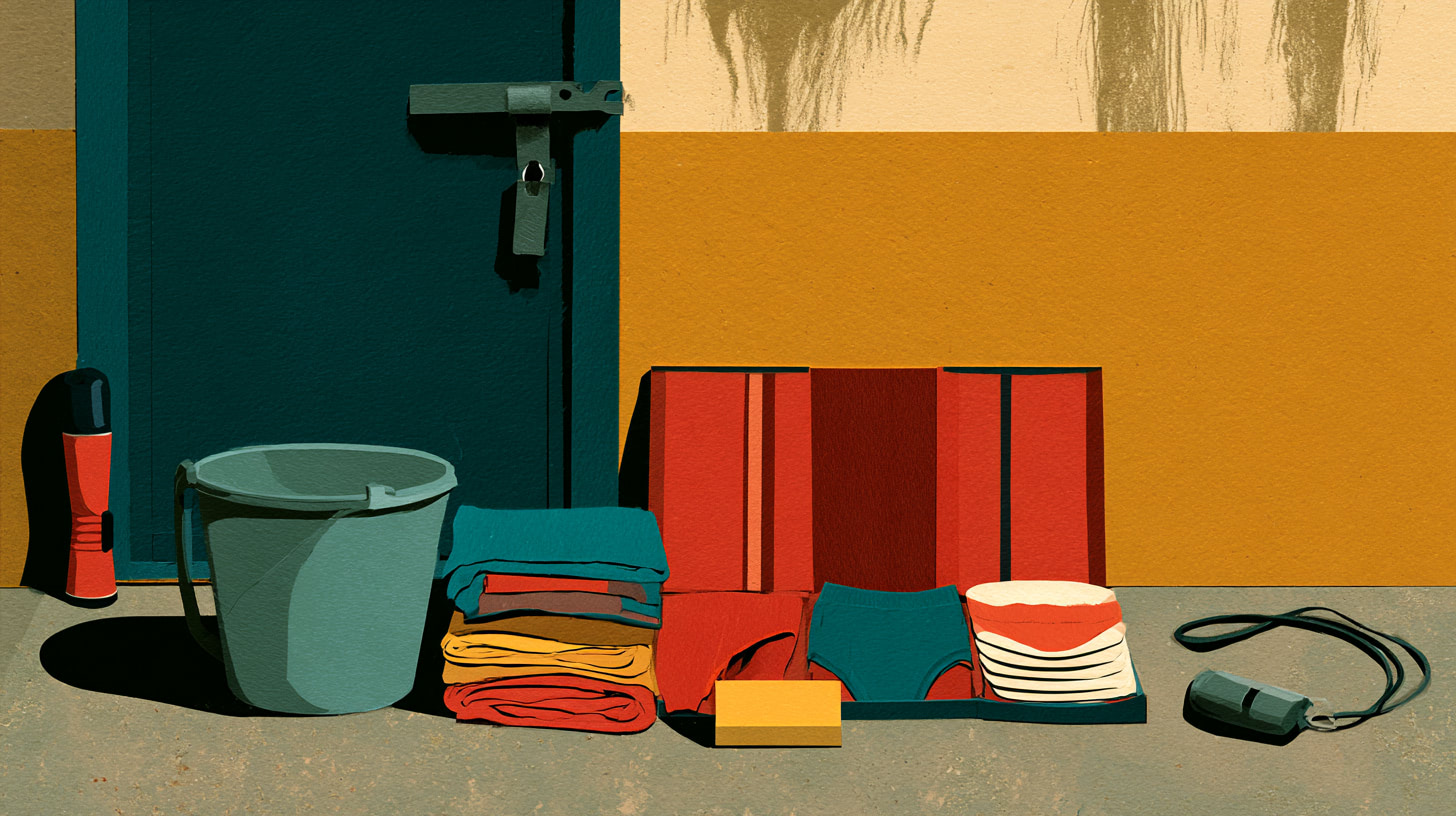
The Buea response also documented what worked, which is the more useful half: referral to the UNFPA-supported Regional Hospital of Buea with a seconded midwife and post-rape kits in stock, 100 dignity kits containing a bucket, reusable sanitary pads, underwear, soap, loincloths and a whistle, psychological first aid, and awareness sessions on gender-based violence (UNFPA Buea assessment).
Two women in that response described what a dignity kit is for. Agnes M., a household head who sold peanuts to support five children and lost all her belongings, said the kit helped her “to regain a dignified life.” Mary K. said: “The underwear, loinclothes and reusable sanitary pads donated by UNFPA are very useful for me at this difficult moment. I can now overcome shame, discrimination and stigma.” Both are exact quotations from the UNFPA report. Both describe relief from stigma rather than receipt of a commodity. A kit handed over without privacy, or missing the whistle, or arriving three weeks late, does not deliver what these women describe.
The Buea numbers carry one caveat. The figures of about 442 women of reproductive age including 47 potentially pregnant women, plus 232 adolescent girls and 210 adolescent boys, are attributed within the UNFPA report to UNHCR preliminary data rather than a completed census, and describe a smaller event (UNFPA Buea assessment). They should shape what Fako measures rather than estimate what Fako contains.
The mortality record, and what it can carry
All three people killed in the Limbe landslide were adult women, one of them pregnant and losing her unborn child, while the sole survivor pulled from the same house was an adult man (DREF Operation MDRCM045). This is one household rather than a sample, and it cannot support a claim about landslide mortality across the event. Independent media confirms the toll and the pregnant victim but not the sex of the other two deceased, leaving that detail resting on the DREF alone (BaretaNews). What the record does establish is that this operation was triggered by an event that killed a pregnant woman, which makes the missing obstetric pathway a specific gap rather than a theoretical one.
Authorities had already flagged the site. The Prefect issued an eviction injunction for hillside populations above Limbe, and the Minister of Housing and Urban Development ordered securing of at-risk public spaces, both before the fatal landslide (DREF Operation MDRCM045).
Why exposure is structural
Women in this division face higher exposure because of where their income comes from, where they are permitted to build, and what the state has failed to maintain.
Their livelihoods are fixed to a location. Buea documented women concentrated in small businesses immediately around the affected houses (UNFPA Buea assessment). Cameroonian press coverage after the Limbe disaster focused on drainage and urban planning failure (Hilltop Voices). Put together, these two facts produce something neither states alone: when drainage fails repeatedly at the same spot, women trading there absorb repeated losses, so each flood compounds the last.
Terrain adds a second layer. Buea sits on the slopes of Mount Cameroon and has experienced recurring lahars, rainfall-driven volcanic mudflows, most recently in April 2026 (Global Voices). UNFPA named the underlying condition after the 2023 event: a geologically unstable area on the slopes of an active volcano, exposed to landslides and mudflows from torrential rain and poor urbanisation, for which investment in preparedness is described as imperative (UNFPA Buea assessment). Peer-reviewed appraisal of Cameroon’s hazard profile finds natural hazards have the lowest frequency but the highest single-incident fatality potential, while socio-natural hazards affect the largest numbers across the widest areas (GeoHazards).
Conflict adds a third. The DREF confirms armed groups operate in outlying Fako localities, and that a “ghost town” shutdown interrupts movement and economic activity in Limbe every Monday, with normality from Tuesday to Sunday (DREF Operation MDRCM045). One day in seven, a woman cannot reach a clinic, a market or a distribution point. This constraint predates the flood and will outlast it, consistent with the longer-running crisis described in official country policy assessment (UK Home Office) and with research linking environmental stress to social tension in marginalised communities (EBSCO).
Household-level research supports the DREF’s targeting logic. A study of smallholder farmers’ subjective flood resilience found asset ownership, indigenous knowledge and livelihood diversification increased resilience, while household size decreased it (The International Journal of Climate Change: Impacts and Responses). That study covers farming households rather than the entirely urban Fako caseload, so it supports the reasoning without transferring as measurement. The DREF’s decision to prioritise households with more than seven members and unemployed heads rests on published evidence.
Change over time: what the crisis added
Before 5 August, women in Limbe lived with a weak but functioning baseline: recurring flood exposure, a weekly mobility shutdown, a national reproductive health and protection programme funded at under half its requirement, and a 2025 audit identifying adolescent girls as particularly affected by gender-based violence risk in this region (CPAoR safety audit). The flood introduced no new category of risk. It removed the two things that made the baseline survivable, the shelter and the trading pitch.
The funding trajectory shows how little slack existed. UNFPA required USD 4,013,060 for reproductive health and protection services in Cameroon in 2026 and had secured USD 1,828,933 as of its January situation report (UNFPA situation report no. 40, January 2026). By May the secured figure reached USD 1,944,046 against the same requirement, roughly 48% (UNFPA situation report, May 2026). Four months added about USD 115,000 to a gap above USD 2 million. Fako’s needs land on that shortfall.
The hazard itself is escalating in the same city. The 2023 Limbe flood affected roughly 2,000 people and 300 households, against roughly 12,000 people and 1,500 households in 2026, a sixfold increase (DREF Operation MDRCM045), corroborated by an independent shelter-sector mission report on the earlier event (Shelter Cluster).
Coping and capacity: who is already working
National gender-based violence infrastructure exists and can be connected to. UNFPA reported 4,699 people reached through awareness sessions, 62% of them women and adolescent girls, alongside 560 women and girls in psychosocial recovery activities such as sewing and food production in dedicated safe spaces, with case managers trained in survivor-centred care and referral pathways updated and disseminated (UNFPA situation report no. 40, January 2026). The Northwest and Southwest Mental Health and Psychosocial Support Technical Working Group, under UNFPA technical leadership, has as its first pillar the decentralisation of coordination to divisional level, the level at which Fako is governed.
Local actors have moved. The Fako Elite Development Organization Douala Branch sent a formal letter of condolence to the Paramount Chief of Limbe after the landslide, and in Buea a community workshop run by ESFA and Hope of Change worked with single mothers on positive parenting and women’s rights during the same period (K-News). Women-led organisations including Reach Out Cameroon, BEBOF, ABEMO, AMEF and the Hadassah Foundation operate in this division. Theresia Ngoe, AMEF’s Livelihood and Empowerment Officer, has described on record the discrimination women-led organisations meet when seeking humanitarian funding (UN Women).
The Red Cross brings its own capacity: 25 volunteers deployed in Limbe with a commitment that at least 30% are women, a WASH National Response Team member, feasibility studies from 2022 and 2023 confirming community preference for cash, a functioning May 2023 cash distribution in the same city, and framework agreements with financial service providers holding local presence (DREF Operation MDRCM045). The IFRC country plan commits to supporting the National Society on protection, gender and inclusion and on community engagement and accountability, and the approach in the larger 2024 floods appeal emphasised involving communities, particularly women, in decision-making (IFRC Cameroon country plan 2026). Whether that commitment becomes a funded contract and a seat at the table remains open.
Methods, and what would strengthen them
This is a secondary data review. It draws on the full 20-page DREF operational document, the March 2023 UNFPA Buea rapid assessment and safety audit, UNFPA national situation reporting for January and May 2026, a government-media damage assessment, a global hazard monitoring platform, local press, and peer-reviewed literature on gendered flood vulnerability, intersectionality and Cameroon’s hazard profile. No primary data was collected, and no focus group discussions or key informant interviews were conducted.
Triangulation was applied where sources permitted. Scale was checked across the DREF, the hazard platform and government-media reporting, and the disagreement is reported rather than resolved. Gendered impact pathways were established from the Buea assessment and cross-checked against the DREF’s own budget lines and indicators to separate what is addressed from what is not. Structural drivers were checked against peer-reviewed hazard literature and local press coverage independently of humanitarian reporting.
The method substitutes a comparable event for the current one. That is defensible at three weeks after onset, and the rubric this document follows permits regional or similar data to backstop analysis when local data is essential and unavailable. It does not replace asking women in Mbende and Gardens what they need. A two-day exercise pairing Red Cross volunteers with staff from a Fako women-led organisation, running the Buea instrument in the affected neighbourhoods, would strengthen this analysis more than any other single change.
C. Recommendations
1. Overarching: treat the Buea 2023 assessment as this operation’s gender baseline, and close the three safeguarding gaps before the first large distribution.
- Who acts: Cameroon Red Cross Society national leadership, with IFRC technical support.
- Do this: Circulate the Buea assessment to all seven sector leads this week. Complete the outstanding child safeguarding risk analysis, and adopt at minimum an interim child safeguarding policy and a whistleblower reporting channel before the 500-household cash distribution and the 1,484-kit distribution proceed.
- Why: The National Society has a PSEA policy but no child safeguarding, whistleblower or anti-sexual harassment policy, and cash and dignity kit distribution are recognised high-risk activities for exploitation by those controlling access to aid (DREF Operation MDRCM045).
- Pay for it from: CHF 71,943 Secretariat Services or CHF 35,140 National Society Strengthening. No new appeal needed.
- Done when: Risk analysis signed off and interim policy circulated to all 25 volunteers before the first transfer cycle.
2. Build the promised gender analysis on the Buea instrument, co-authored with a Fako women-led organisation, within 30 days.
- Who acts: Cameroon Red Cross Society PGI focal point, IFRC, UNFPA, and a named Fako women-led organisation as co-author.
- Do this: Adapt the Buea rapid assessment and safety audit design rather than commissioning a new instrument. It already covers women-led household share, waterpoint and latrine destruction, menstrual hygiene access, demolition-driven displacement, night safety, livelihood loss in fixed-location commerce, psychosocial distress, and gender-based violence in host populations. Add disability status and urban location as cross-cutting axes, since the DREF records both.
- Why: The DREF commits to a gender analysis at the outset and none existed at publication, while a directly comparable instrument already exists for this hazard in this division (DREF Operation MDRCM045; UNFPA Buea assessment).
- Pay for it from: A discrete line within the CHF 36,705 PGI budget, covering local partner staff time and data collection.
- Done when: Analysis published within 30 days with a local organisation named as co-author rather than as a data source.
3. Protection: name the receiving facility and the referral pathway before the next transfer cycle.
- Who acts: Cameroon Red Cross Society health and PGI sector leads, with UNFPA and the Regional Delegation of Public Health.
- Do this: Identify by name the facility that will receive pregnant women, survivors of violence, and women needing reproductive health care from the affected neighbourhoods. Confirm post-rape kits are physically in stock there. Write the pathway on a single page and give it to all 25 volunteers. Buea used the UNFPA-supported Regional Hospital of Buea with a seconded midwife as this anchor.
- Why: The operation was triggered by an event that killed a pregnant woman, funds 1,484 dignity kits, and has no obstetric or antenatal pathway, while its protection referral circuit is still being built and targets 30% of cases (DREF Operation MDRCM045; UNFPA Buea assessment).
- Pay for it from: CHF 26,455 Health budget line, agreed at the weekly operational meeting.
- Done when: A named facility, a named contact and confirmed kit stock reach volunteers before the next transfer.
4. Protection: treat the hillside eviction as a displacement event with its own protection plan.
- Who acts: Cameroon Red Cross Society PGI focal point, with the Prefect’s office and the Limbe town hall.
- Do this: Establish where evicted households will go before or alongside enforcement of the injunction, and place protection monitoring on host-household arrangements. Raise the 30% referral target for the eviction-affected caseload.
- Why: In Buea, demolition in the risk zone pushed families into host households and open-air sleeping, and the safety audit subsequently found gender-based violence cases within the host population. Limbe now sits at the same point in that sequence (UNFPA Buea assessment; DREF Operation MDRCM045).
- Pay for it from: CHF 36,705 PGI budget, coordinated through the Departmental Committee.
- Done when: A written destination and monitoring arrangement exists for evicted households before enforcement.
5. WASH: make menstrual hygiene and safe night latrine access named objectives with their own indicators.
- Who acts: Cameroon Red Cross Society WASH sector lead and the deployed WASH National Response Team member.
- Do this: Add two indicators to the WASH component. First, latrines restored or installed with lockable doors and lighting on the approach route. Second, women and girls reporting they can manage menstruation privately. Include both in the post-distribution monitoring questionnaire, which already uses a stratified sample with focus groups.
- Why: Buea documented destroyed latrines forcing women and girls to ask neighbours for access, very challenging at night, and broken pipes making menstrual hygiene management a stated challenge. Fako’s CHF 30,896 WASH component lists 500 kits and 60,000 water treatment tablets without naming either issue (UNFPA Buea assessment; DREF Operation MDRCM045).
- Pay for it from: CHF 30,896 WASH budget line, agreed before the first distribution.
- Done when: Both indicators appear in the monitoring framework and in the first post-distribution monitoring round.
6. Participation: give a Fako women-led organisation a voting seat on the Departmental Committee, and fund at least one directly.
- Who acts: The Prefect of Fako as committee chair, and IFRC and donors funding MDRCM045.
- Do this: Add a named seat for a Fako women-led organisation representative to the Departmental Committee, with the same standing as the mayor and health authorities. Separately, disburse flexible grants directly to organisations such as Reach Out Cameroon, BEBOF or AMEF, without a competitive proposal process, to extend dignity kit distribution, psychosocial support and community-based referral beyond what 25 volunteers can reach.
- Why: The committee running this response includes no women’s organisation or civil society representative. The MHPSS working group’s first pillar is decentralising coordination to divisional level, which is this committee. AMEF staff have documented the barriers women-led organisations face reaching exactly this funding (DREF Operation MDRCM045; UNFPA situation report no. 40; UN Women).
- Pay for it from: A ring-fenced local-partner allocation within the CHF 36,705 PGI line, disbursed inside the window ending 31 January 2027.
- Done when: A named seat confirmed in writing within two weeks, and one signed grant agreement with a Fako women-led organisation.
7. Report against the disaggregated targets already published, and translate everything.
- Who acts: Cameroon Red Cross Society monitoring and evaluation team, with IFRC Cluster PMER support.
- Do this: Break every operational update and the final report down by women, girls under 18, men and boys under 18, and report disability status separately rather than folding it into a total. Produce all community-facing materials in English and Pidgin.
- Why: The DREF already publishes a disaggregated target and commits to Kobo collection disaggregated by sex, age and disability, so the risk is reversion to the 12,000-person aggregate. The operation’s lessons-learned section records that a lack of English materials in a previous cholera and monkeypox response limited effectiveness in this English-speaking region (DREF Operation MDRCM045).
- Pay for it from: No new funding. A reporting-template requirement within the existing PMER budget.
- Done when: The first operational update carries the four-way breakdown and disability figures.
Limitations, and what remains unknown
This analysis is a secondary data review produced three weeks after onset. No affected women, girls, men or boys were consulted, and no Fako-based organisation took part in producing it. Organisations named in the recommendations were identified from published mandates. No funding, decision-making authority or credit has yet moved to any local actor as a result of this document, and Recommendation 6 exists to correct that. That absence, rather than the data gaps, is this document’s principal limitation.
What remains unknown or uncertain:
- No sex-disaggregated figure exists for the affected population as distinct from the targeted population, and no count exists of pregnant or lactating women in the caseload.
- The claim that all three landslide fatalities were women rests on the DREF alone. Media reporting confirms the toll and the pregnant victim but not the sex of the other two deceased. That outlet frames the region in separatist political terms and should be read as politically framed even where its casualty reporting aligns with the DREF.
- Scale is contested between roughly 12,000 affected and 3 deaths with 100 displaced, across differing time windows and differing measures. Neither figure is discarded here.
- A Kumba, Meme County flooding event on the same date has not been reconciled with the DREF figures.
- The Buea figures of about 442 women of reproductive age and 47 potentially pregnant women are attributed within the source to UNHCR preliminary data rather than a completed census, and describe a smaller 2023 event.
- The specific percentage breakdowns by violence type in the 2025 CPAoR safety audit could not be independently confirmed against the full report and are therefore not reproduced.
- The smallholder resilience study covers farming households rather than the urban Fako caseload, and no sex-disaggregated resilience scores from it could be verified, so none are cited.
- The Global Voices article describes lahars, a different mechanism from the August rainfall flooding and landslide, and is used only as evidence of compounding hydro-geological exposure.
- No peer-reviewed gender-specific research on the August 2026 Fako floods was identified, which is expected at this stage.
Where this document infers rather than establishes, it says so. The link between fixed-location women’s commerce and cumulative rather than one-off losses is an inference drawn from two verified facts, not a measured finding, and it is offered as a basis for the assessment in Recommendation 2.
References
- ACAPS. Cameroon. ACAPS country analysis, updated 2026 Jun 22. https://www.acaps.org/en/countries/cameroon
- Bang HN, Miles L, Gordon R. A concise appraisal of Cameroon’s hazard risk profile: multi-hazard inventories, causes, consequences and implications for disaster management. GeoHazards. 2022;3(1):55-87. https://doi.org/10.3390/geohazards3010004
- BaretaNews. Three killed as floods ravage Fako, Meme. BaretaNews, 2026 Aug 4. https://www.bareta.news/three-killed-as-floods-ravage-fako-meme/
- Cameroon Red Cross Society, International Federation of Red Cross and Red Crescent Societies. Cameroon: floods in Fako, DREF operation no. MDRCM045. ReliefWeb, 2026 Aug 20. https://reliefweb.int/report/cameroon/cameroon-floods-fako-dref-operation-no-mdrcm045
- Cameroon Tribune. Limbe: human casualties, huge material damages recorded. Cameroon Tribune, 2026 Aug. https://www.cameroon-tribune.cm/article.html/79608/fr.html/limbe-human-casualties-huge-material-damages-recorded
- CARE International. Rapid gender analysis toolkit. CARE, n.d. https://www.care.org/our-work/disaster-response/rapid-gender-analysis/
- Child Protection Area of Responsibility, UNICEF. GBV safety audits for children: key findings (North-West/South-West Cameroon, 2025). ReliefWeb, 2026 Aug 3. https://reliefweb.int/report/cameroon/cpaor-gbv-safety-audits-children-key-findings-nwsw-cameroon-2025
- European Union Agency for Asylum. Cameroon: treatment of women by separatist groups, including information on sexual and gender-based violence, in the Northwest and Southwest (Anglophone) regions. COI query response Q50. EUAA, 2023 Oct 11. https://www.euaa.europa.eu/sites/default/files/publications/2026-01/2023_10_EUAA_COI_Query_Response_Q50_Cameroon_Treatment_of_women.pdf
- Global Disaster Alert and Coordination System. Overall green flood in Cameroon from 04 Aug 2026 01:00 UTC to 06 Aug 2026. GDACS, 2026 Aug. https://www.gdacs.org/report.aspx?eventid=1104078&episodeid=1&eventtype=FL
- Global Protection Cluster. Cameroon protection analysis update. Global Protection Cluster, 2025 Mar. https://globalprotectioncluster.org/sites/default/files/2025-04/pau25_protection_analysis_update_cameroon_march2025_final.pdf
- Global Voices. Buea, Cameroon is facing recurring floods despite a lack of rain. Global Voices, 2026 May 7. https://globalvoices.org/2026/05/07/buea-cameroon-is-facing-recurring-floods-despite-the-lack-of-rain/
- Hilltop Voices. Cameroon press review, Monday 10 August 2026. Hilltop Voices, 2026 Aug 10. https://www.hilltopvoices.com/2026/08/cameroon-press-review-monday-10-august.html
- Human Rights and Legal Research Centre. Minister Atanga Nji distributes presidential relief to 500 flood-affected families in Limbe, South West Region of Cameroon. HRLRC, 2026 Aug 14. https://hrlrc.org/2026/08/14/minister-atanga-nji-distributes-presidential-relief-to-500-flood-affected-families-in-limbe-south-west-region-of-cameroon/
- Human Rights Watch. “I live in constant peril”: discrimination, lack of economic autonomy and violence against women in Cameroon. Human Rights Watch, 2026 Jun 24. https://www.hrw.org/report/2026/06/24/i-live-in-constant-peril/discrimination-lack-of-economic-autonomy-and-violence
- International Federation of Red Cross and Red Crescent Societies. Cameroon country plan 2026. IFRC, 2026. https://go-api.ifrc.org/api/downloadfile/92508/Cameroon_INP_2026
- K-News. FEDO Douala branch extends condolences to Limbe over August 5 flood, landslide. K-News, 2026 Aug. https://simonkalla20.wixsite.com/knews/post/fedo-douala-branch-extends-condolences-to-limbe-over-august-5-flood-landslide
- Ministry of Women’s Empowerment and the Family, Cameroon. Report: situational analysis of gender-based violence in Cameroon 2025. MINPROFF, 2025 Aug. https://minproff.gov.cm/wp-content/uploads/2026/04/Report-Situational-Analysis-Gender-Based-Violence-In-Cameroon-2025_ENG_s.pdf
- Ncube A, Mangwaya PT, Ogundeji AA. Considering an intersectional lens in agriculture and climate change: a systematic literature review. African Journal of Gender, Society and Development. 2021;10(4):163-186. https://journals.co.za/doi/abs/10.31920/2634-3622/2021/v10n4a8
- Reach Out Cameroon. About. Reach Out Cameroon, n.d. https://www.reachoutcameroon.org/about
- Sadki R (2026). Reimagining Rapid Gender Analysis as decolonial practice. https://doi.org/10.59350/rr0d3-3pk55
- Reda Sadki (2026). A decolonial feminist perspective on gender equality programming in the Global South. Reda Sadki: Learning to make a difference. https://doi.org/10.59350/epedf-5nc60
- Samoura DA, Visiy EB, Younis AYI. Factors underlying smallholder farmers’ subjective resilience to floods. The International Journal of Climate Change: Impacts and Responses. 2024;16(2). https://cgscholar.com/bookstore/works/factors-underlying-smallholder-farmers-subjective-resilience-to-floods
- Shelter Cluster. Buea flood shelter cluster mission report and lessons learned. Shelter Cluster, 2023 Apr 7. https://www.sheltercluster.org/north-west-south-west/documents/buea-flood-shelter-cluster-mission-report-and-lessons-learned
- United Kingdom Home Office. Cameroon: North-West/South-West crisis. Country policy and information note, version 2.0. UK Home Office, 2020 Dec. https://www.justice.gov/eoir/page/file/1345186/dl?inline=
- United Nations Office for the Coordination of Humanitarian Affairs. Cameroon – South-West Region: information note on floods in Limbe, 24 July 2023. ReliefWeb, 2023 Jul 26. https://reliefweb.int/report/cameroon/cameroon-south-west-region-information-note-floods-limbe-24-july-2023
- United Nations Office for the Coordination of Humanitarian Affairs. Cameroon: North-West and South-West situation report no. 76, April 2025. ReliefWeb, 2025 Jun 2. https://reliefweb.int/report/cameroon/cameroon-north-west-and-south-west-situation-report-no76-april-2025
- United Nations Population Fund. More than 400 women and girls in need of protection and sexual and reproductive health services following flooding in Buea in Cameroon’s South-West Region. UNFPA Cameroon, 2023. https://cameroon.unfpa.org/en/news/more-400-women-and-girls-need-protection-and-sexual-and-reproductive-health-services-following
- United Nations Population Fund. UNFPA Cameroon humanitarian situation report no. 40, January 2026. UNFPA Cameroon, 2026 Jan. https://cameroon.unfpa.org/sites/default/files/pub-pdf/2date26-date3/UNFPA%20Cameroon%20Hum%20SitRep%20%2340_January%202026.pdf
- United Nations Population Fund. Situation report on the crisis in Cameroon, May 2026. UNFPA, 2026 May. https://www.unfpa.org/resources/situation-report-crisis-cameroon-may-2026
- UN Women. Interview with Theresia Ngoe: women’s organizations want to be seen as partners, not only be told what to do. UN Women, 2023 Aug. https://www.unwomen.org/en/news-stories/interview/2023/08/interview-with-theresia-ngoe-womens-organizations-want-to-be-seen-as-partners-not-only-be-told-what-to-do