
Motivation barely predicts how well immunization programmes perform. Learning culture does.
The evening programme in Addis Ababa on 25 November 2026 was already running late. For more than half an hour, members of the community of practice for health promotion and social and behaviour change convened by the Africa Centres for Disease Control and Prevention (Africa CDC) had introduced themselves in English, French, Portuguese and Amharic, from Mauritania to Botswana, from ministries of health to airport security. Kenya’s Permanent Secretary had joined from Nairobi to tell the room that sovereignty is partnership. Then Priscilla, head of social and behaviour change at Africa CDC, turned to TGLF’s Reda Sadki, to answer a question that many people trained to trust numbers ask: does a community of practice actually change anything on the ground, and what kind of evidence could show it?
Dr Priscilla Kusena (moderator): I know already that you have a few slides from The Geneva Learning Foundation. I would like to start with you.
Reda Sadki (TGLF): Thank you. I am very proud that The Geneva Learning Foundation is a partner of Africa CDC.
Priscilla asked me to share some of our experience with communities of practice. I realize I may be the only slide presentation tonight, and the last one. So apologies for both those things. But I hope this will nourish your thinking and the actions you are already taking around this community of practice for social and behavioural change.
You may wonder what the point of a community of practice really is. For people trained in public health, it sounds soft. Nice to have. In fact, we have evidence that the conditions a community of practice builds are strongly associated with how health workers rate the performance of their programmes. That is the bottom line. Performance is the holy grail we are all chasing. So tonight I want to speak in evidence too.
I am going to do three things. First, I am going to give you seven principles. They all sound very nice, and you may ask: why these seven and not others? Then I am going to give you an example from our work with Gavi, the Vaccine Alliance, as part of the Zero-Dose Learning Hub, where 1,964 people came together for an inter-country exchange. And then I am going to show you the data that link these principles to performance, and what those data can and cannot tell us. Does that sound of interest, even as the final presentation of the day?
Seven principles. They are actions, things you should do to foster the kind of learning that improves performance. As I go through them, think about the community of practice that Africa CDC is building around social and behaviour change. How are you doing these things? How are you supporting them through the community of practice?
The first one is to create continuous learning opportunities. Learning is designed into work, so that people learn on the job, not only in a workshop once a year.
The second one is to promote dialogue and inquiry. You may say: is that not what a community of practice is for? Yes. It is necessary, but it is not sufficient. Inquiry means asking not only: are we doing things right? But also: are we doing the right things? It is one ingredient. You need others to make a good meal.
Third, encourage collaboration and team learning. Work is designed to use groups to access different modes of thinking. What we have here tonight is a pretty good example.
Fourth, establish systems to capture and share learning, both high-technology and low-technology systems.
Fifth, empower people toward a collective vision. Sixth, connect the organization, the system, to its environment.
And seventh, leaders provide leadership for learning.
So where do these seven action imperatives come from? They come from two researchers, Karen Watkins and Victoria Marsick, who studied how organizations change. Together, these seven make up what they call learning culture. They define it very simply: the capacity for change. Here is a way to think about it. Someone in your team has a great idea. How likely is it that the idea will be taken up, adapted and scaled? That likelihood is your learning culture. And it can be measured, with a validated questionnaire that asks people about the norms and practices they see around them at work, not about their individual behaviour.
Research by Watkins, Marsick and their colleagues also found that two of the seven, leadership for learning and systems to capture and share learning, are key drivers of performance. Keep that in mind. Leaders matter a great deal here.
Now the practical case: the Gavi Zero-Dose Learning Hub. With the Hub partners and Gavi, we developed an inter-country experience exchange. It may have been the first time that Bangladesh and Mali came together in an exchange, and it focused on zero-dose children, the children who have never received a single vaccine. Again, ask yourself: how does this transpose to social and behaviour change? How consistent is it with what the Africa CDC community of practice is already doing?
We went through four stages. Reflect: 1,964 people registered, and they shared 421 experiences. Share: listening, sharing, giving and receiving feedback on those experiences. Apply: moving from reflecting and sharing to actual application, turning those experiences into action. And then lead change.
Now, I know what some of you are thinking. Experiences? Those are anecdotes. A convenience sample. The people who chose to write are not representative of all health workers. That is true. But ask what question you are asking. If the question is how often something happens across the whole workforce, you need a representative sample. If the question is whether something happens at all, and how it works, you do not. An experience here is not a story told over tea. It is a detailed, context-specific account: what the situation was, what happened, who was involved, and how it turned out. A representative sample would tell us how often. It would not change the fact that it happened, or how it worked.
Let me give you one. Eyamu Joseph, a community health worker with the Ministry of Health in a district of Uganda, used existing community structures and community savings groups to find and record zero-dose children. When all 16 children were identified, a mobile health team came so that they could receive their vaccines. In his words: “To date the district team has adopted and the health workforce are now conducting specialized immunization outreaches to catch up and identify zero dose children.” That is a working solution, under real constraints, from someone facing the same constraints as his peers. It does not tell us how often this works. It tells us that it can work, and what to try elsewhere.
One of the key questions any community of practice should ask itself is: did we reach the right people? Among the participants who answered our registration questions, 89% said they were directly involved in zero-dose work. And it was not only people from districts and facilities. 27% worked at national level, and so on. That is a description of who came, not of the whole workforce. But for a community of practice, who came is exactly the question.
Why does that mix matter? In 2020, during our COVID-19 Peer Hub, independent researchers at the University of South Australia looked at the action plans participants wrote. Two-thirds of the ideas cited in those plans came from peers working at different levels of the health system. That is not an estimate about anyone else. It is a direct observation of how knowledge actually moved in that network: the district learning from the nation, and the nation learning from the district.
Then we asked for feedback. How do we measure and evaluate? 195 English-speaking participants answered. All 195 said they would use what they learned in their work, that the exchange increased their commitment, that they would join the next event, and that they would invite colleagues. 97% said they learned something new. Now, be careful with these numbers. The people who answer a feedback form are usually the most engaged, so treat 100% as a ceiling, not an average. And it is what people intend, not yet what they did. What it does tell you is that, among those who engaged, nobody said this was useless.
So that is a practical example of how you can rapidly grow a community of practice, and then track and measure what it does and how it does it. From what I have seen, this is very consistent with what this community of practice is doing.
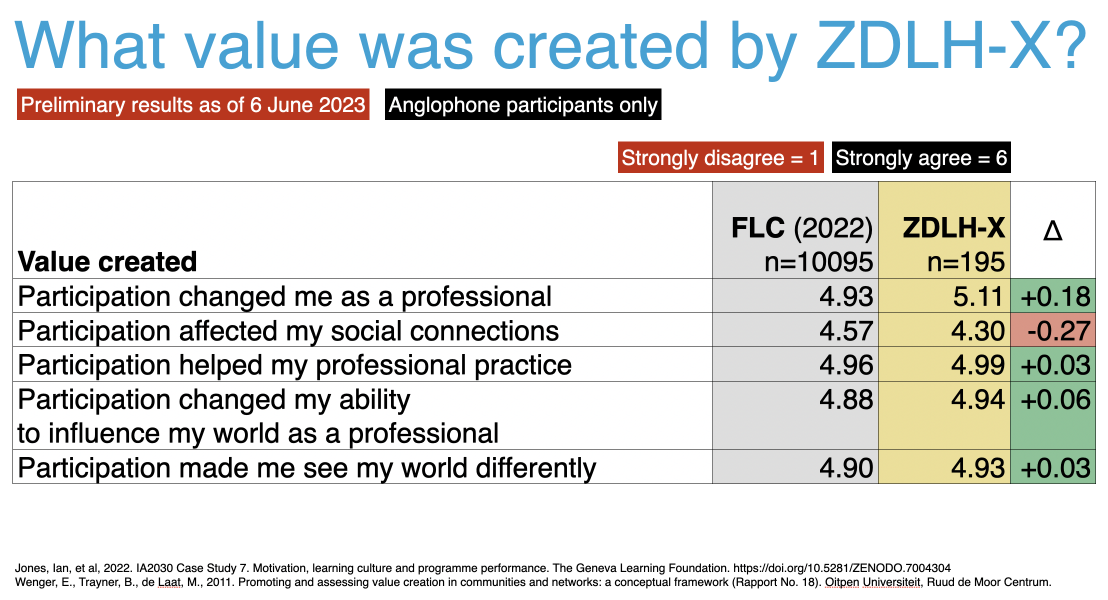
Now the measurement. We measure five dimensions of what we call value creation. This is not familiar in global health. It is not familiar in immunization. But it is grounded in evidence from learning science. The question is simple: what does a person actually gain from taking part? We ask each participant to rate five statements on a scale from 1 to 6. Did this change me as a professional? Did it affect my social connections? Did it help my practice? Did it change my ability to influence my world? Did it make me see my world differently?
Now, a score of 5 on its own means very little. Nobody can tell you in the abstract what a 4.9 means. So we compare. In 2022, during a learning cycle of the Movement for Immunization Agenda 2030, we obtained a baseline from 10,095 health workers, after a four-month programme. Every new initiative can be compared with it. It is a bit like comparing a new vector control tool with a historical baseline.
And here is what the comparison showed, in preliminary results. The 195 participants in this single exchange gave scores very close to that four-month baseline, and slightly higher on professional change. The one score that was lower was social connections. One plausible reason: one event is not enough time to build new relationships. These are two different groups of volunteers, so read this as a signal, not a verdict.
What we found is that a community of practice, networked action, is not a magic bullet. It is an opportunity for transformation. We were able to break it down into five simple steps. First, you connect peers. Second, you link local practice to global guidance. Third, you tailor to local contexts and communities. Fourth, you harness experience, what people know because they are there every day, to drive improvements. And fifth, that strengthens learning culture.
A man working at district level in Ghana put it more simply: “If health workers do not share their challenges and solutions together, we are bound to fail.”
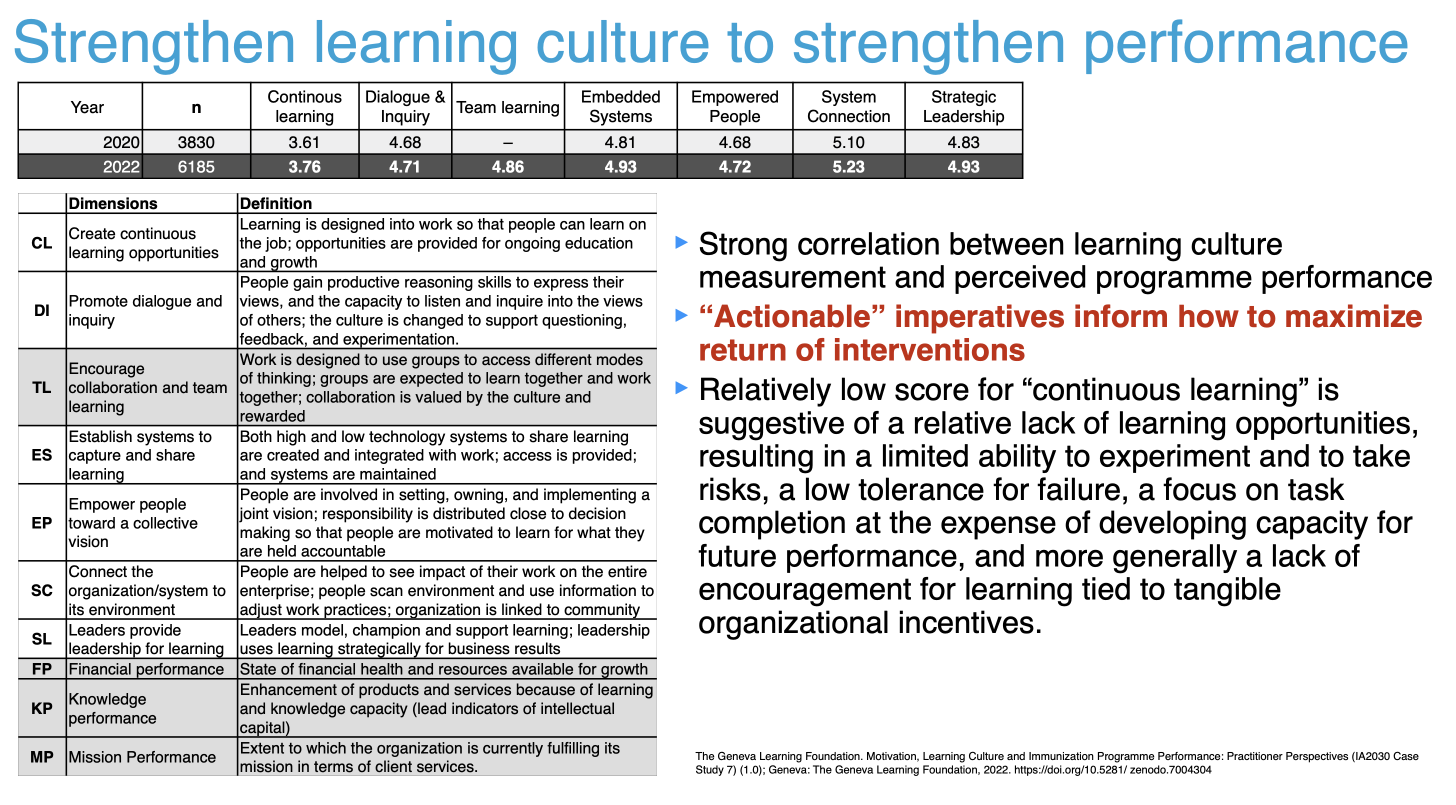
Now the evidence. Remember learning culture, the capacity for change. We measured it twice, at large scale, along the seven dimensions I shared with you. Once in 2020, with 3,830 health workers, and once in 2022, with 6,185. Look at the scores, on a scale of 1 to 6. Almost everything sits between about 4.7 and 5.2. That is quite a high baseline. Scores were a little higher in 2022 than in 2020, though these were not the same people, so we cannot call that change. But one number does not fit. Continuous learning: 3.6, then 3.8. Almost a full point below everything else, in both years.
And think about who answered. These are health workers who chose to join a learning network. If anyone should rate learning opportunities highly, it is them. And still, continuous learning comes last. So this is a conservative finding. Among the wider workforce, it is unlikely to be better. Hold on to that. I will come back to it.
So now we have a number for learning culture, the environment that enables change. And we asked the question every epidemiologist in this room would ask: is it associated with performance? We asked the same 6,185 health workers to rate their programme on two things. Mission performance: how well is the programme actually delivering its services? And knowledge performance: is the programme getting better because of what its people learn? Yes, these are perceptions. Self-report. The same people rate both their learning culture and their performance, and that can inflate any association. A bigger or more representative sample would not fix that. Only an independent measure of performance would.
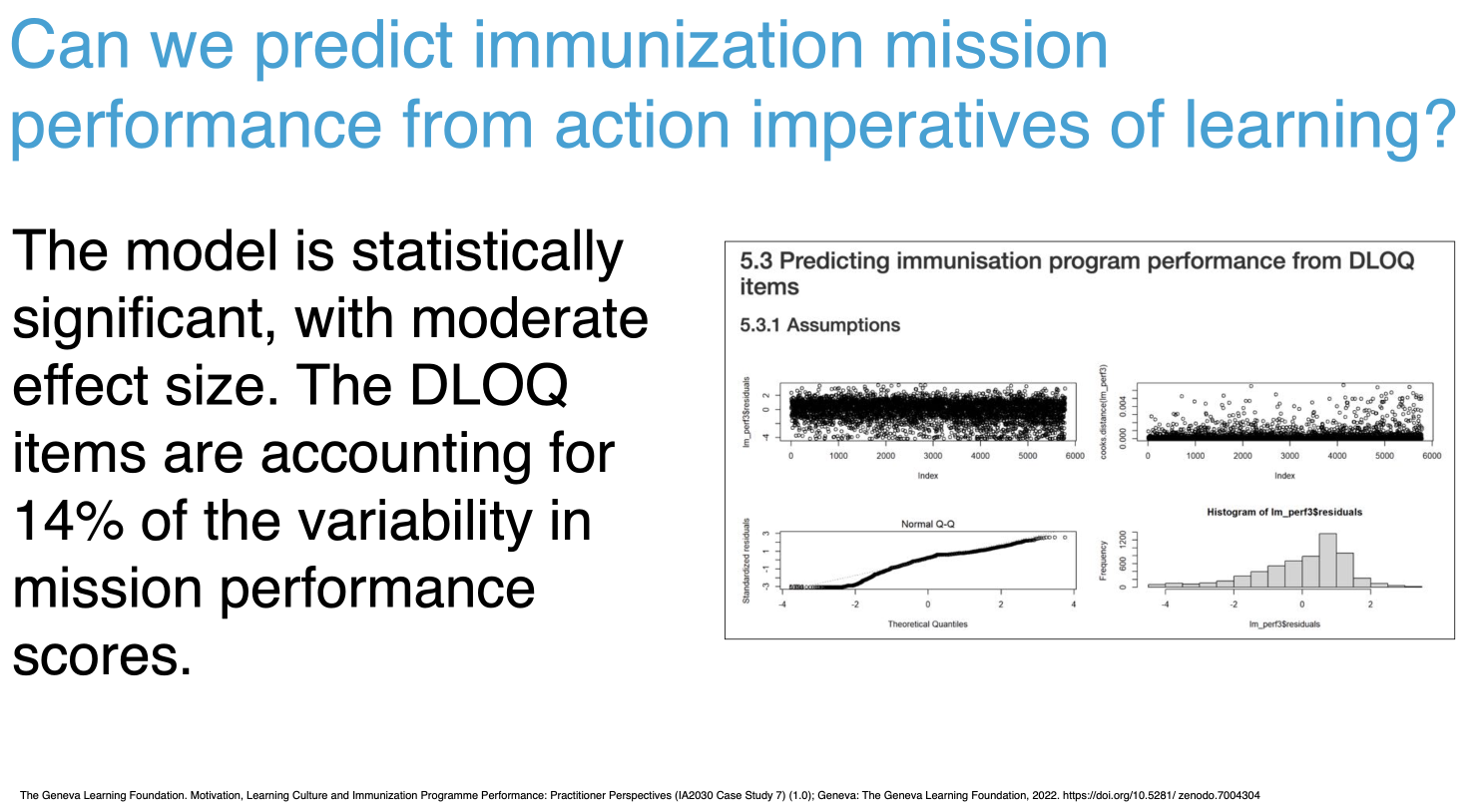
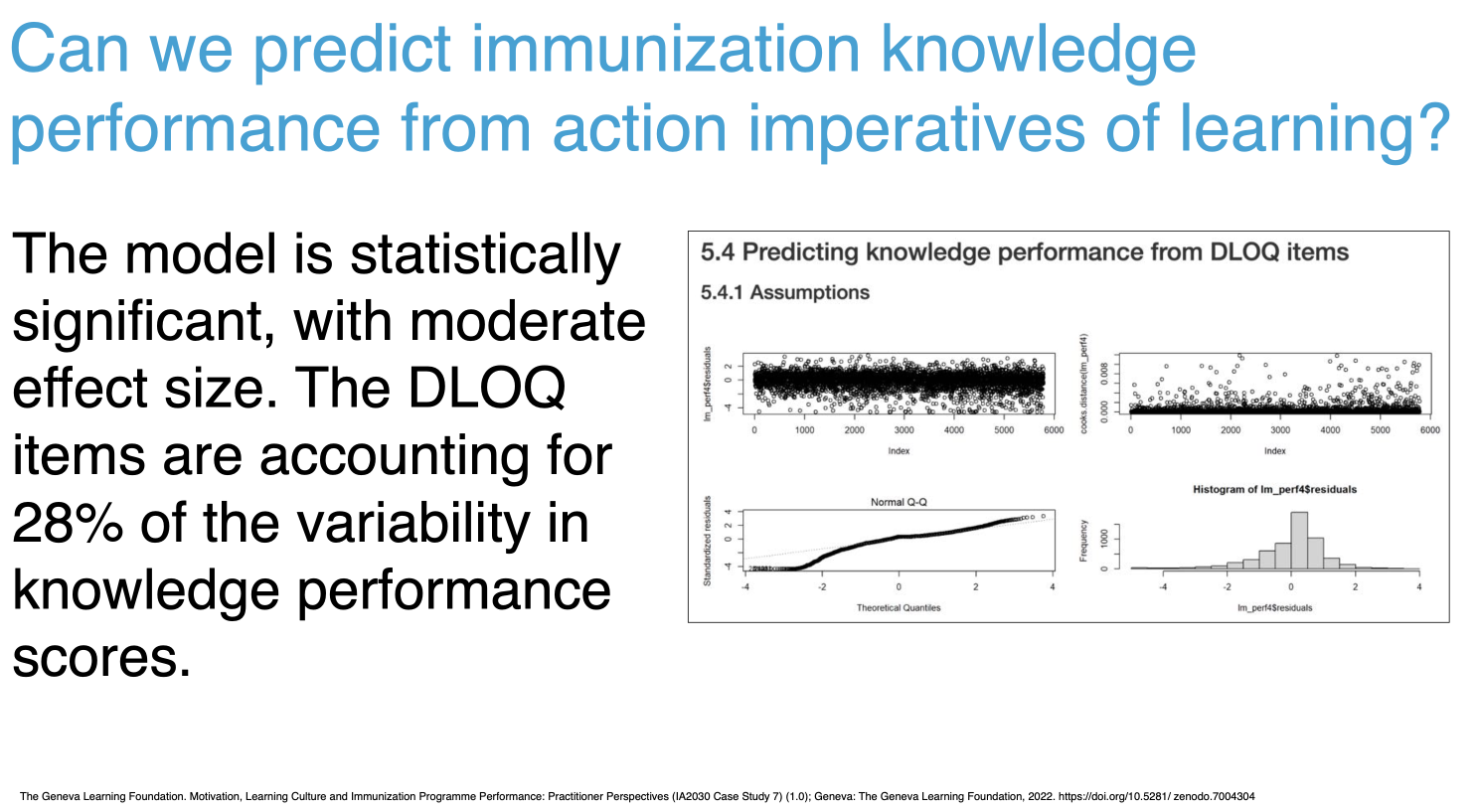
Let me explain what the numbers mean. Programmes differ. Some perform well, some less well. The question is: if I know one thing about a team, how much of that difference can I predict? That is what we mean by the share of variability explained. If I know the learning culture, I can explain 14% of the differences in mission performance, and 28% of the differences in knowledge performance. Statistically significant, with a moderate effect size.
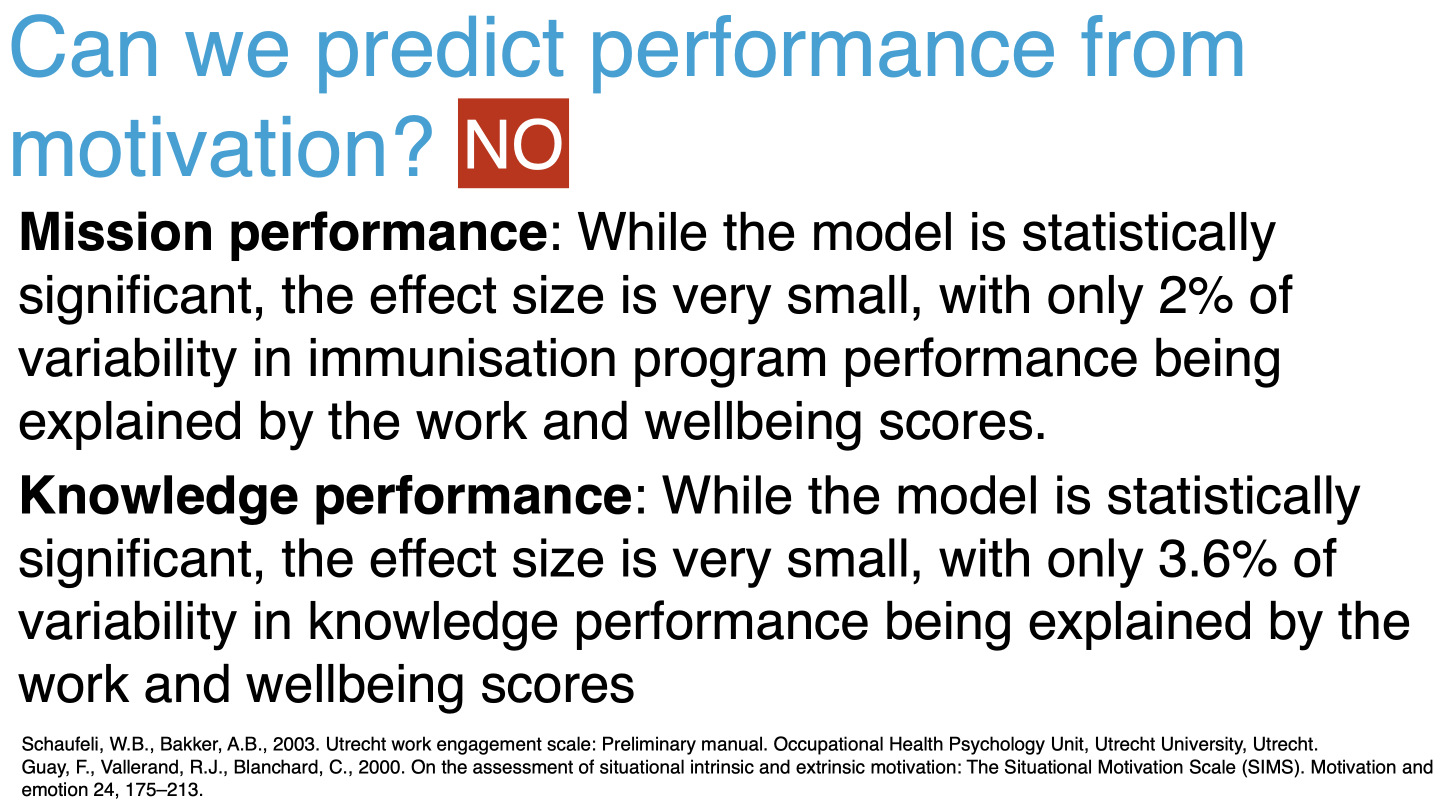
Is that a lot? Compare it with motivation. Many people assume motivation is what makes performance: if your staff are motivated, performance will follow. We measured motivation too, in the same people, with standard scales of work engagement and motivation. Motivation explained only 2% of the differences in mission performance, and only 3.6% in knowledge performance. Two percent. Almost nothing. Learning culture explains about seven times more than motivation, for both measures.
And here is why that comparison matters. Both are self-reported. Both come from the same people, who chose to take part. So whatever bias comes from self-report, or from who answered, applies to both. And still, one explains seven times more than the other. That contrast does not depend on a representative sample.
I am going to stop here. I am not going to dive further into the evidence. Basically, if you invest in these seven action imperatives, a community of practice is a particularly effective way to do it, especially when it is linked to tangible actions and follow-up on the ground.
What do I mean by follow-up on the ground? In what we call the Impact Accelerator, each participant commits on Monday to one concrete action to complete by Friday. On Friday, they report back to their peers. And when they see an improvement, they must convince those peers that the change came from what they did, and would not have happened otherwise. Peers who know your context are hard to fool. That is how we move from learning to results that have been tested by people who know the work.
So what can you take from all this? These data do not prove that a community of practice causes better performance. That would need a different study design. But they show a strong, consistent association, and they show it is far stronger than the one everyone assumes, with motivation. That is a sound basis to invest, and to measure as you go. Invest particularly in the weak dimensions. And remember the number that did not fit: continuous learning, the lowest score in 2020 and still the lowest in 2022.
What does a low score in continuous learning look like in real life? Few chances to experiment. Little room to take risks. Low tolerance for failure. A focus on finishing today’s task, at the expense of building the capacity to perform tomorrow. Does that sound familiar? That is why we believe a community of practice is a great investment. When it is designed in the right way, it supports and drives continuous learning, exactly where immunization programmes scored weakest.
There is a cost to not doing this. When health workers depend on outside expertise instead of building their own problem-solving, they fall into what researchers call a capability trap. One woman working at a health facility in Nigeria described how she got out of it: “Before I joined Teach to Reach, I had thought that I could not make a difference in my community (institution) without external funding support. But all that changed and I was able to work with a few collaborators in my institution to influence staff to accept and take the COVID-19 vaccination.” One case. But one case is enough to show that the assumption, no change without outside money, does not always hold.
So I hope we connected the dots. We have measurement systems that give us quantitative evidence. Not just “this felt like a good event, I enjoyed it, I did a lot of networking”, but evidence that can strengthen the case for communities of practice like the one the social and behaviour change community is building now. I hope that was not too long, and I hope I held your attention. Thank you.
Moderator: Global learning indeed. We shall be learning as a community of practice. Thank you very much.
References
- Argyris C. Single-loop and double-loop models in research on decision making. Adm Sci Q. 1976,21(3):363-75. https://doi.org/10.2307/2391848
- Guay F, Vallerand RJ, Blanchard C. On the assessment of situational intrinsic and extrinsic motivation: the Situational Motivation Scale (SIMS). Motiv Emot. 2000,24(3):175-213.
- Jones I, Watkins KE, Sadki R, Brooks A, Gasse F, Yagnik A, et al. Motivation, learning culture and immunization programme performance: practitioner perspectives (IA2030 Case Study 7). Version 1.0. Geneva: The Geneva Learning Foundation, 2022. https://doi.org/10.5281/zenodo.7004304
- Repenning NP, Sterman JD. Nobody ever gets credit for fixing problems that never happened: creating and sustaining process improvement. Calif Manage Rev. 2001,43(4):64-88. https://doi.org/10.2307/41166101
- Sadki R. Ideas Engine: what is The Geneva Learning Foundation’s insights mechanism? The Geneva Learning Foundation [Internet]. 2020 Sep 17 [updated 2026 Jan 6]. Available from: https://www.learning.foundation/2020/09/17/ideas-engine-what-is-the-geneva-learning-foundations-insights-mechanism/
- Sadki R. The capability trap: nobody ever gets credit for fixing problems that never happened. Reda Sadki: Learning to make a difference [Internet]. 2024 Feb 23. https://doi.org/10.59350/a43gx-fbr50
- Sadki R. Why lack of continuous learning is the Achilles heel of immunization. Reda Sadki: Learning to make a difference [Internet]. 2024 Mar 3. https://doi.org/10.59350/93ad8-nds22
- Sadki R. What is double-loop learning in global health? Reda Sadki: Learning to make a difference [Internet]. 2024 Mar 17. https://doi.org/10.59350/s4xtw-b7274
- Sadki R. Learning culture: the missing link in global health between learning and performance. Reda Sadki: Learning to make a difference [Internet]. 2024 Mar 18. https://doi.org/10.59350/wkrvk-nfk82
- Sadki R. Why guidelines fail: on consequences of the false dichotomy between global and local knowledge in health systems. Reda Sadki: Learning to make a difference [Internet]. 2024 Nov 26. https://doi.org/10.59350/55rt9-8ts48
- Sadki R. What is The Geneva Learning Foundation’s Impact Accelerator? Reda Sadki: Learning to make a difference [Internet]. 2025 Jul 17. https://doi.org/10.59350/redasadki.21161
- Sadki R. How do we measure the value of peer learning for malaria national programme staff? Reda Sadki: Learning to make a difference [Internet]. 2026 Mar 22. https://doi.org/10.59350/ect8s-1xv35
- Schaufeli WB, Bakker AB. Utrecht Work Engagement Scale: preliminary manual. Utrecht: Occupational Health Psychology Unit, Utrecht University, 2003.
- The Geneva Learning Foundation. COVID-19 Peer Hub combats vaccine avoidance amid pandemic [Internet]. 2020 Nov 27. Available from: https://www.learning.foundation/2020/11/27/covid-19-peer-hub-combats-vaccine-avoidance-amid-pandemic/
- Watkins KE, Marsick VJ, editors. In action: creating the learning organization. Vol. 1. Alexandria (VA): ASTD Press, 1996.
- Watkins KE, O’Neil J. The Dimensions of the Learning Organization Questionnaire (the DLOQ): a nontechnical manual. Adv Dev Hum Resour. 2013,15(2):133-47.
- Watkins KE, Sandmann LR, Dailey CA, Li B, Yang SE, Galen RS, et al. Accelerating problem-solving capacities of sub-national public health professionals: an evaluation of a digital immunization training intervention. BMC Health Serv Res. 2022,22:736. https://doi.org/10.1186/s12913-022-08138-4
- Wenger E, Trayner B, de Laat M. Promoting and assessing value creation in communities and networks: a conceptual framework. Rapport 18. Heerlen: Ruud de Moor Centrum, Open Universiteit, 2011.
- Yang B, Watkins KE, Marsick VJ. The construct of the learning organization: dimensions, measurement, and validation. Hum Resour Dev Q. 2004,15(1):31-55.