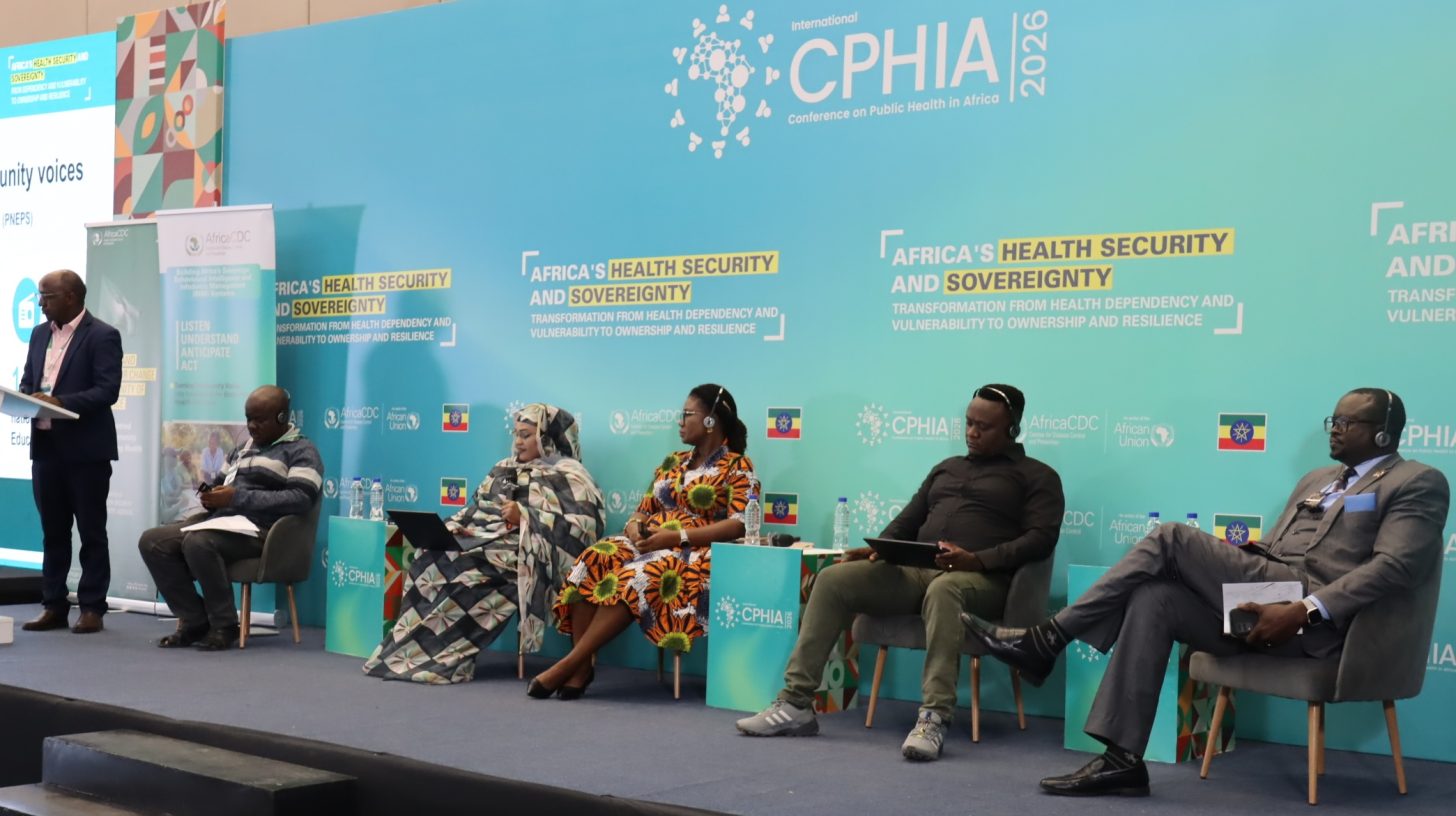
Public health representatives of five countries had just described the Behavioural Intelligence and Infodemic Management Systems, known by the “BIIM” acronym, they are building to listen to their communities. A researcher had explained how her company can now turn trust into a score that reliably predicts whether people will be vaccinated. The moderator then pointed out that the people who hold trust are health workers, and turned to TGLF’s Reda Sadki with two questions: how can countries learn from each other, and how can frontline health workers both feed signals into these systems and use what comes out of them? Sadki began with a habit of epidemiology that, in his view, keeps such systems from hearing what health workers know.
This is the full, expanded transcript of Reda Sadki’s remarks, at the side event “Building Africa’s Sovereign Behavioural Intelligence and Infodemic Management (BIIM) Systems”, convened by the Africa Centres for Disease Control and Prevention (Africa CDC) in Africa Hall, Addis Ababa, on 26 November 2026, at the International Conference on Public Health in Africa (CPHIA).
Moderator: So the question really is this: how can countries learn from each other’s experience?
And how can frontline health workers both feed signals into Behavioural Intelligence and Infodemic Management (BIIM), and use what comes out of it?
Reda Sadki (TGLF): Those are great questions, and I think what is important is how they are related to each other.
So, how countries can learn from each other.
My sense is that this is already happening in many ways.
We heard tonight about a West African regional body working with Sierra Leone to strengthen capacity in other West African countries, and about colleagues from Senegal who helped train Ghana’s teams.
Zimbabwe told us it wants to learn from Ghana, Kenya and Sierra Leone.
I think there is an open question about who should be at the table in intercountry learning.
Is it only national planners, the national teams and country partners from different countries that should be in such an an exchange?
There is obviously very high value in that.
But we found that including people from other levels of the health system in such exchanges has a very productive effect.
Burundi described a health system with four levels, down to the community, and each of those levels has something to bring.
When we analysed the action plans health workers wrote in our COVID-19 Peer Hub, two-thirds of the ideas they cited came from peers working at different levels of the health system.
In Nigeria, with UNICEF and the National Primary Health Care Development Agency, 4,300 health workers produced more than 400 root cause analyses in four weeks, and found that the causes they had assumed were wrong.
Is it lived experience, or is it an anecdote?
On the second question, I will try to be quick, given the time constraint.
There is a major challenge in how we listen to health workers so that they feed signals into this system.
How do we support them, recognize them, and show that we value the specific experience that they have, because they are there every day?
Burundi said it tonight: the community health worker must be listened to.
A health worker is not a sensor.
She is a professional, with the capacity to think, act, and learn.
In the opening, we heard that communities must see their voices influence decisions.
Health workers need to see the same thing, or we are mining the frontline.
For anybody trained in epidemiology, there is a major problem, because a personal experience, something that happened to me as a health worker, something that I saw, is an anecdote.
And an anecdote is classified as the lowest form of evidence in the hierarchy of evidence.
Think of Burundi’s community health workers facing the rumour that a vaccine causes sterility.
They were vaccinated themselves, ten or twenty years ago, and they have children.
By the rules of epidemiology, that is an anecdote.
In that community, it may be the best available insight.
As long as we do not challenge that, and recognize that in some contexts the health worker’s experience may be highly valuable, we are likely to be stuck.
And that is difficult, because it requires not just a change in consideration for health workers, but a change in how we know what we know: in the epistemology that we use in public health to recognize what is legitimate knowledge, and who is a legitimate knower.
The opening keynote listed local knowledge as one of the streams this system must bring together.
Philosophers call its dismissal epistemic injustice.
It also has a practical cost, in the Age of Intelligence. A workforce systematically taught that its own observation does not count as knowledge is less likely to challenge a fluent machine.
The last point I want to make is that, at TGLF, we have been building an insights system since 2020.
We ask health workers for experiences, not reports.
Our team reads every contribution and gives a collection of shared experiences back to the community as quickly as possible, before distilling the patterns that no single person could see.
Ghana already has an insights team that sits every day to triangulate signals.
The cycle we heard about tonight ends with feedback to the community, and our Ideas Engine is built on the same principle of reciprocity.
How will the Age of Intelligence impact BIIM?
2026 is the year we integrated our human insights team into a fully agentic AI team.
In March, we hired our first AI co-worker, and we used artificial intelligence agents to rebuild our insights pipeline.
When we get health wrong, people die. This calls for thinking through how we design artificial intelligence to serve community health
For this system, I have not heard the words artificial intelligence tonight, but I know they are obviously in everyone’s minds.
There are obvious major threats and significant potential opportunities.
The most obvious threats are the exponential growth in disinformation and misinformation, and the growing impossibility of distinguishing fake from true content.
Kenya had to train journalists during Ebola because misinformation had entered the reporting itself.
Imagine everything we have seen in disinformation so far, multiplied by ten, by a hundred or by a thousand.
That is what we will face in the coming months.
At the Agentic AI Summit in Berkeley in August, a Google trust and safety leader told us: “You should not ask ‘is this fake or real?’. You should actually ask: is this trusted? What is the context?”
Health workers in the community can provide that context.
Then there is the opportunity, which is a capability to listen and to respond faster, better, and at scale, like never before.
In the opening, sovereignty was defined as owning your systems and your data.
The representative of Ghana Health Service said they have been waiting since February for an application programming interface, an “API”, to adapt its own dashboard.
For a ministry of health, I would say sovereignty comes down to three abilities: to choose, to leave, and to judge.
You can download a model, but you cannot download a data centre.
And the ability to judge depends on people who can check what a machine produces, what we call the validation tether.
So I would call on Member States and Africa CDC to prioritize looking at this, because the pace of change is frightening.
Ghana: TGLF Scholars form a country-wide network to lead change
And one last point, to respond to our esteemed colleague from Ghana about her stated bottleneck: inadequate capacity of district workforce to use Ghan’s rumour reporting tool.
Our TGLF Scholar network in Ghana is countrywide and operates within the Expanded Programme on Immunization (EPI), and I am betting they would love to take up this challenge.
These are health workers who have continuously trained to improve as leaders for health, learning from and supporting each other.
They are not specifically focused on social and behavioural change, but they would certainly be willing to contribute to solving the challenge you are facing with the capacity of the district workforce.
I learned tonight that Ghana’s call centre became redundant when partner support ended after COVID-19.
In Nigeria, more than half of the health workers kept collaborating in the Immunization Agenda 2030 Collaborative, a nation-wide peer learning exercise led by TGLF Scholars with NPHCDA and UNICEF, after the funding closed.
We need insights and intelligence to navigate a complex, fast-changing world. Sustaining the BIIM
Thank you.
Moderator: Thank you, and thank you again for your time.