Invite your colleagues on WhatsApp, Gmail, Yahoo Mail, LinkedIn, Telegram, Facebook, or X/Twitter.
When the clinic closes, the pharmacy is empty, or the roads are blocked, how do you ensure continuity of care for people living with noncommunicable diseases (NCDs)?
Dr. Shanthi Mendis, retired Senior Adviser for Noncommunicable Diseases at the World Health Organization, presents this open-access peer learning ‘primer’ or short course in collaboration with The Geneva Learning Foundation.
This short primer course is your entry point. It opens the door to the full Certificate peer learning programme for noncommunicable diseases (NCDs).
Who this is for?
This primer is for any health professional who may find themselves as a first responder during a crisis.
Noncommunicable diseases (NCDs) are long-term health conditions like heart disease, cancer, diabetes, and chronic respiratory diseases.
They are not passed from person to person, but they require daily management that often breaks down completely during a crisis.
You may feel that NCDs are too complex for you to manage.
However, in a humanitarian emergency, no specialists may be available.
This guide will help you to make sense of what you can do to help.
For medical doctors and specialists
You may already have deep clinical expertise in NCDs.
However, treating these conditions in a well-equipped hospital is very different from managing them in a disaster zone.
This primer helps you adapt your knowledge to settings where you lack diagnostics, medicines, or referral options.
It challenges you to make clinical decisions based on limited resources and helps you lead your team effectively under pressure.
Why complete this primer?
This primer is your gateway to the full Certificate peer learning programme for noncommunicable diseases. It introduces you to the full programme that will prepare you and your community to support people living with NCDs before, during, and after a humanitarian crisis.
- It respects your time and bandwidth. We know you are busy. We use short readings to share the critical information that can actually help you.
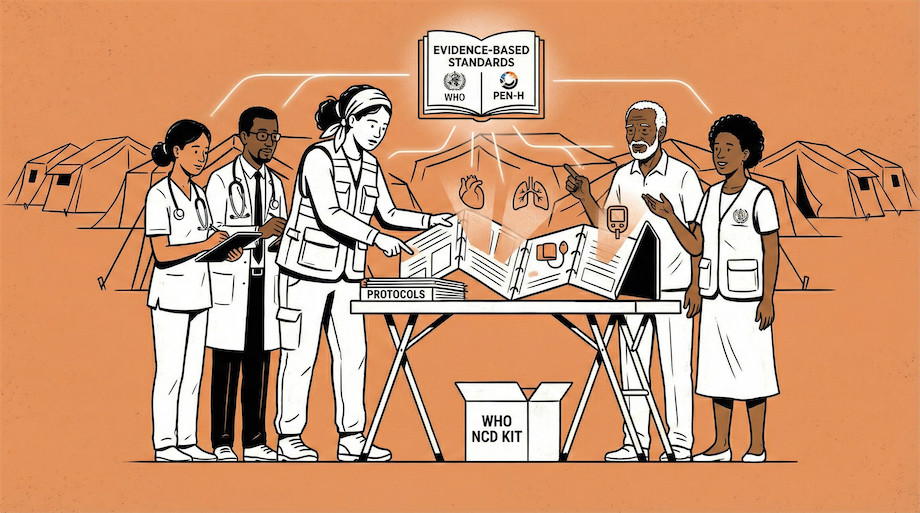
- You get knowledge vetted by a global expert. Dr. Shanthi Mendis led the development of the WHO Package of Essential NCD Interventions (PEN) and its adaptation for humanitarian settings (PEN-H). You can trust that the concepts you learn are grounded in the highest global standards.
- You join a global peer network. You will not learn in isolation. You will connect with colleagues from other countries who face similar challenges. This network allows you to share experiences and find solutions that you cannot find in a textbook.
- You focus on your reality from day one. This is not abstract theory. In this primer, you will focus on the challenges you face.