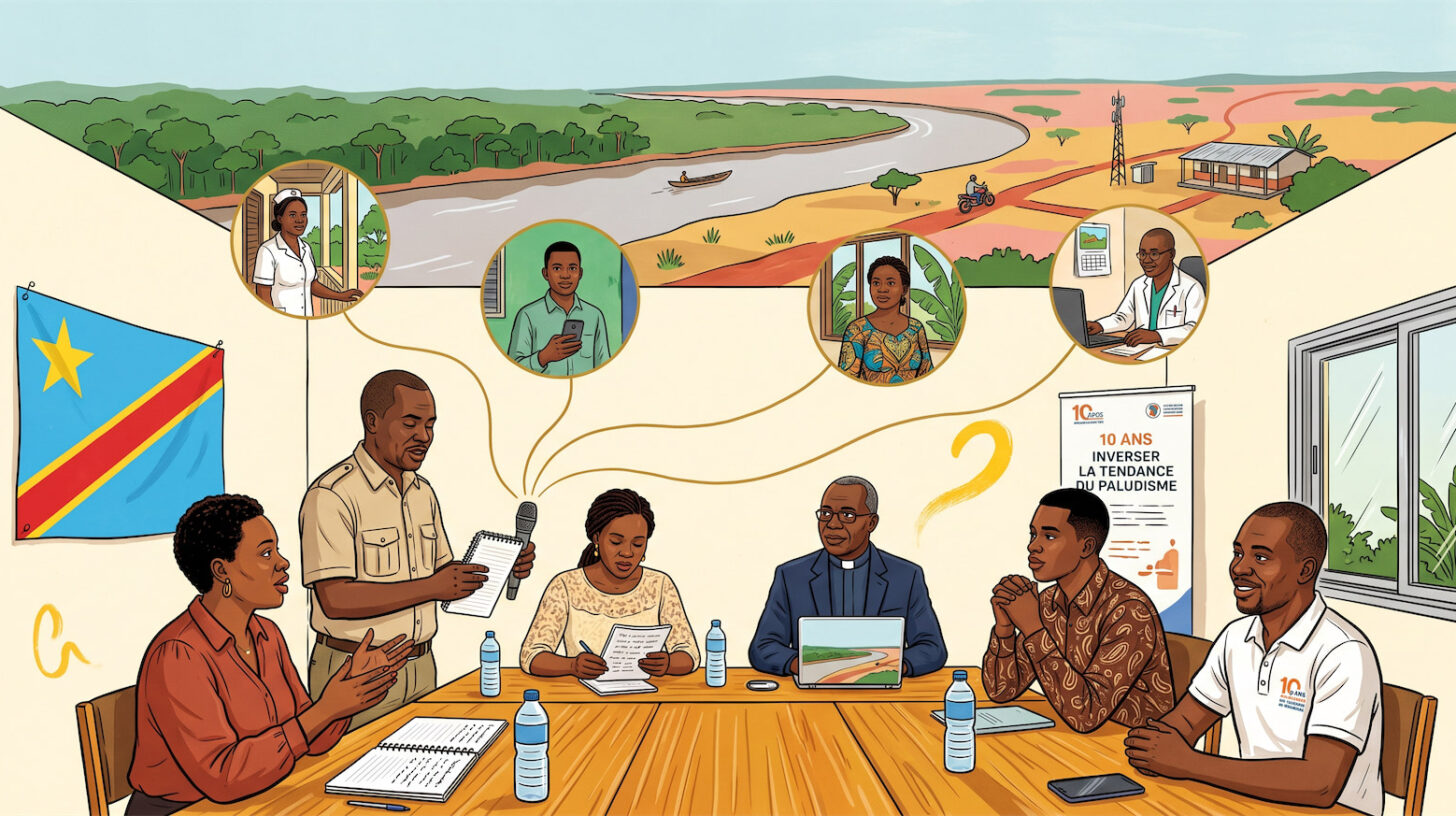
KINSHASA (May 9, 2026) — On a Saturday morning, in a room at Mazenod University in Kitambo, the first people to arrive open the windows and line up chairs.
Several wear white shirts with The Geneva Learning Foundation’s name on them.
132 Congolese Scholars had signed up to join.
43 joined online from Mbandaka, Kasumbalesa, Lubumbashi, Bukavu, and Kalemie.
On screen, colleagues from other countries were waiting too.
They came from Cameroon, Mali, Côte d’Ivoire, Niger, Benin, Chad, Togo, and Tanzania.
::: wp-block-group Patrice Bamulenga is one of the Foundation’s Ambassadors for the Democratic Republic of the Congo. He came up with the idea for this meeting. He is the first one to speak. :::
Who else stands at the crossroads between those from Kinshasa and those from somewhere else?
Henri Stanley NYAFE is a nurse in Mbandaka.
Viviane Mukalay is a nurse at Neema health center, in the Sakania health zone, at the border with Zambia.
She joined online from Kasumbalesa.
François Mufolo Balimumu spent twenty years at Sendwe Hospital in Lubumbashi before working with Médecins Sans Frontières and Alima.
This year, The Geneva Learning Foundation is celebrating ten years.
In Kinshasa, the Scholars from the DRC decided to celebrate what they call their ten years.
They booked the room, ordered the shirts, and invited a group of experts who agreed to come on a Saturday morning.
They ended the event with sign-ups for the Foundation’s next program on malaria.
Charlotte Mbuh, the Foundation’s director of programs, joined online from Ébolowa, Cameroon.
Reda Sadki, founder, joined from Geneva.
Both listened for more than three hours before they spoke.
What a morning means in the hardest-hit country
According to the World Health Organization, the DRC has 12.6% of all malaria cases in the world and more than one out of every ten deaths from the disease.
After Nigeria, it is the country hit hardest by malaria.
These numbers are not just background.
For each family, every case means paying for medicine, a test, a ride to the clinic, and a meal they will not eat.
An organization that celebrates grassroots action
At the opening, Charlotte Mbuh summed up what the morning was about. “Today is not a training. It is a celebration. We are celebrating ten years of peer learning, ten years of sharing what we know, ten years of better care for our communities.”
She kept going. “Ten years is not the end. It is the start of something new. We want to start this next step with our malaria program, Turning the Tide on Malaria.”
The host, Papa Emmanuel Kibambe, a doctor at the Ministry of Health, set the tone. “Today is Saturday. Someone dropped everything to come share what they learned. For free. This belongs to us.”
Three experts came.
Dr Meshach Motombo, a malaria specialist.
Father Robert Bougard, a missionary priest, ecologist, and head of the Laudato Si’ Movement in Congo.
Dr Léopold, who leads continuing education at the health ministry.
None of them came to pitch a project.
None of them came to sell a product.
An organization that held its tenth birthday celebration and launched its next program on the same morning knows who it is.
The Geneva Learning Foundation calls itself, in its founding documents, an organization that does things.
The celebration in Kinshasa was proof.
Closing the gap between what we know and what we do
The science on malaria is known.
The medicines work.
Treated bed nets work.
The R21 vaccine was added to the DRC’s vaccine schedule in October 2024 (WHO Africa, December 18, 2024). It is now rolling out in pilot health zones in Central Kongo.
Guidelines exist.
Yet the country saw nearly two million more cases from one year to the next.
The gap between what is written in plans and what happens in a health zone has a name: the “know-do gap.”
In Kitambo on May 9, the DRC Scholars named it. They described, in their own words, what it takes to close it.
Technical knowledge from the guidelines.
Local knowledge from communities.
Peer knowledge that flows when colleagues from another province share how they did it.
Viviane Mukalay, a nurse in Sakania, told the story of when her work changed.
“We used to stay inside the clinic. We did not think we needed to work with community health workers or really partner with the community. But when I came to the meeting here, I got the courage to go out to the community, work with them, and make decisions together—especially with the community health workers. When kids miss their shots, we give the cases to the community health workers. They know the addresses. They go find the families and bring them in. The number of kids who are behind on vaccines or who missed the first dose went down.”
Her nursing degree, her protocols, her knowledge of medicines—none of it was enough on its own.
Her work changed when the knowledge of community health workers, who knew where people lived, met the experience of colleagues from other health zones, shared at network meetings. That joined with what she already knew.
Henri Stanley NYAFE, online from Mbandaka, spoke during the panel.
He addressed Dr Meshach politely and asked a question the official numbers do not ask. “You say malaria cases are going down. But we are seeing more deaths from it.”
Then he turned to bed nets. “You are missing something. Mosquitoes bite us between 5 and 7 p.m. Working people are outside under trees then. There are no nets there.”
Mr. NYAFE’s point, made from a city in the northwest, raised a real question that universal guidelines do not cover. People are exposed at dusk, away from home.
This is the kind of talk where new ideas can form. Where old ideas get stronger.
On the chat, François Mufolo Balimumu wrote from Lubumbashi. “The expert’s numbers are too low. We have many traditional healers in our neighborhoods and villages. They never report to the main health center.”
His point was not alone.
It matches one of the eight findings from the Foundation’s new report, Turning the Tide on Malaria. In several countries studied, more than 60% of fever care happens outside public health centers.
A participant from a hard-to-reach area spoke about displaced people.
“They are already living with inequality. They do not get supplies or trained staff. They are left on their own.”
Later that morning, Francklin Muzo Mukungu, a program officer at the NGO DJPDI, asked to speak. He reported a medicine shortage in the Pinga and Kibua health zones in Walikale territory. Malaria, diarrhea, and measles cases were rising.
When he registered, he wrote, “We are living through violence in North Kivu.”
He knew the room could not solve the problem.
He also knew what he just said would stay in the network’s memory. Colleagues in other provinces would now know this was happening.
Father Robert Bougard spoke next and changed the focus.
“Dr. Meshach talked mostly about treatment. We work as ecologists. We focus on prevention.”
He asked the room to look at what the numbers miss.
Water pooling in gutters.
Rising heat.
“A little water sitting anywhere for a few days becomes a hotel where mosquitoes grow.”
His point matched an observation from the “Turning the Tide” report. Young people in Kinshasa maintain gutters by choice. Farmers in Madagascar raise ducks that eat mosquito larvae.
The most surprising moment came from the expert himself.
Questions from the room pressed him on how institutions work. Dr. Meshach said something government officials rarely say in public.
“The malaria program cannot stay under the health ministry. It needs to move up. It should report to the minister’s office, the prime minister’s office, or the presidency.”
The Scholars in the room pushed his point further. Their ground experience moved the argument beyond the bureaucratic box where it started.
This is exactly what the network has claimed for ten years as its own contribution.
Technical knowledge gets stronger when it meets local knowledge and peer knowledge in the open.
Three stories told to the room
The program had planned two testimonies before the panel.
Dr. Noelly Zola, a general practitioner and Foundation ambassador, spoke first about what did not work.
She wanted to join international organizations.
WHO. UNICEF.
You needed a master’s degree in public health.
She applied for scholarships.
None worked.
“When I was discouraged, I got an email from the Foundation. My mother Charlotte asked me to join the learning platform. That is how I started learning online.”
She learned the five-whys method.
She used it in her health zone to find the real reasons behind problems her colleagues saw as only technical.
She spoke plainly about the cost. “I also lost some close relationships because I was working all the time.”
Today she is a Foundation Ambassador. She leads Scholar engagement for malaria training.
Dr. Stanis Mutamba, chief doctor of a hospital center, spoke next.
In 2020 he was leading a water-sampling mission in Nagika.
At the same time he was taking a Foundation course on genital schistosomiasis in women.
The link between the two was not obvious. Then he looked at village patients with the tools from the training.
He found cases no one in the area would have diagnosed.
He supported the women, explained the disease, and organized a response.
His words were simple and closed the sequence. “Train one expert and you transform a community.”
Papa Emmanuel Kibambe, the emcee, slipped his own story between questions. “I have been a Scholar since 2019. I already have seven or eight certifications from this Foundation.” He described what his practice gained. “In knowledge and learning, you do not need big knowledge. Small tricks turn a problem into a solution.”
Three stories. Three ways of holding the diploma in one hand and experience in the other, and bringing both together in one room.
A network that already exists and acts
The strong engagement in Kinshasa is real, not just how we’re telling the story.
When the international call opened, the Foundation had named 314 Ambassadors. 167 of them live in the Democratic Republic of Congo.
The title comes with a job: connect peers, close the gap between international guidance and local action, and build the network from the inside.
To qualify, you must finish at least one Foundation program and complete a four-week activation program.
This is how the “Congolese Movement for Vaccination” started in the DRC.
It began as a habit during the pandemic. In July 2019, Congolese Scholars started meeting every Saturday at 5 p.m. on Zoom to share news, solutions, and questions.
That weekly meeting has grown over the years into a bigger conversation on WhatsApp and video calls. It has never stopped.
What happened in the room in Kitambo on May 9 was making that network visible.
Olenga Okitengeno Rita, a community health worker in Kinshasa, wrote for the tenth-anniversary story collection about finding 121 children who had slipped through the vaccination system in one health zone. She reached more than 80 percent of them.
She did the same work in another zone.
Marcel Muntu Ilunga, a public health expert working with displaced people, vaccinated 93 children from birth to 23 months old in thirty days.
André Claude Mukinayi Kalamba, a nurse in Kalemie, got into a homemade canoe for the first time to vaccinate people on a riverbank where vaccination had been rejected before.
None of these stories came from a funded project.
All of them happened.
The link between guidance and the ground
The Foundation published its new report on April 23, 2026, the day before World Malaria Day. It is called Turning the tide.
It brings together what more than one thousand health workers in sixty-eight countries said, including workers in the DRC.
One of its eight main points opens with a story from Congo.
Dr. Bisimwa Muzusa Emmanuel, a doctor in Bukavu, talks about his own children getting malaria even with bed nets. “Three of my children, ages one, three, and five, got malaria even though they sleep under a bed net. The youngest had to go to the hospital.”
Another point talks about community work to clean drainage ditches in Kinshasa. This is exactly what Brother Robert talked about in the room in Kitambo.
The report connects what happens on the ground with guidance from the World Health Organization.
It records the layer that the guidance was not meant to capture and that tracking systems find hard to measure.
It shows what works in real life.
Reda Sadki, speaking late in the morning, said it this way. “This is a new kind of knowledge that can help a worker. You will not find a guideline that tells you what to do in every case. But you can read it and learn from the experiences of health workers. That includes people who are not doctors. Community health workers, nurses, and midwives.”
The report is available in French and English.
An eight-point summary gives the main results.
A piece published on World Malaria Day explains how to read it.
What happens next
Patrice Bamulenga closed the session with the image of a construction site. “What we started today is one stone in the foundation. Tomorrow we raise the walls. The day after, we put up the roof. And the day after that, people move in.”
Three concrete things came out of this.
The training course Malaria: turning the tide is now open. Scholars who attended can register, and so can their colleagues.
The Foundation’s next monthly meeting is May 14. The Congolese team can join peers from around the world to see the full range of training, action, and leadership opportunities.
And the proof that a national group of Scholars can organize an event this big on its own.
In the last half hour, the room sang the national anthem before the group photo. Comments kept coming through on screen.
Mathieu Kalemayi works in the Congolese office of a partner organization. He wrote, “We will be there to join our efforts against this scourge that grieves us.”
Benoît Sêdégnon is a consultant for Unicef in Benin. He asked how the Beninese network could regain momentum using the Congolese model.
Abdramane Oumarou is a health union representative in Niamey. He wrote that “this is a very useful event, especially for us health workers to improve our knowledge.”
Daniel Mafini is a doctor with the Artemisia House Network of ambassadors. He wondered how to bring his expertise.
Louise Nkusu Lusangu is a Congolese ambassador based in South Africa. She raised the question of academic futures and university partnerships for those who chose this path.
The Kitambo room is just one point in a larger picture that already extends elsewhere.
In Mbandaka, at five o’clock, the window of exposure to the mosquito will open.
On Henri Stanley NYAFE’s phone, and on Viviane Mukalay’s phone in Kasumbalesa, messages will keep moving.
References
- Mbuh, C. and Sadki, R. (April 8, 2026). Ten years already! 10 new opportunities to lead change.
- World Health Organization. (December 2024). World malaria report 2024: regional data toolkit. Geneva.
- World Health Organization, DRC office. (July 2025). 2024 annual report. Kinshasa.
- WHO Afro. (December 18, 2024). DRC strengthens malaria control in children with preventive treatment.
- President’s Malaria Initiative. (2024). Democratic Republic of the Congo malaria profile, FY 2024.
- National Malaria Control Program. (April 2025). 2024 annual report on malaria control activities. Kinshasa. See also pnlprdc.org/rapports-annuels.
- National Malaria Control Program. (2020). National strategic plan for malaria control 2020-2023. Kinshasa.
- Sadki, R. (February 25, 2026). We are the ones who are there every day: how a global network of health workers is closing the last-mile gap.
- Sadki, R. (March 12, 2026). Scholar one day, Scholar always: inside the last-mile global health network that runs on trust.
- Sadki, R. (March 31, 2026). One hand reaching for another: the health and humanitarian workers building a global network from clinics, conflict zones, and community halls.
- Sadki, R. (April 17, 2026). Ten years of peer learning and action: The Geneva Learning Foundation’s alumni, in their own words.
- Sadki, R. (April 17, 2026). Turning the tide: a new insights report demonstrates why health worker knowledge is critical to ending malaria.
- Sadki, R. (May 1, 2026). Turning the tide: 8 practical insights to end malaria.
- Sadki, R. (May 3, 2026). World Malaria Day: what frontline health workers are saying about malaria and why it matters.
- The Geneva Learning Foundation. (April 2026). Malaria in Africa: turning the tide. Teach to Reach 11, listen and learn report no. 19, French edition. Geneva.
- The Geneva Learning Foundation. Registration page for the special event on malaria and the Turning the Tide malaria program.